A mobile phone cover glass is a product built by "stacking" films: on the glass substrate grow, in sequence, functional coatings for antireflection, anti-fingerprint, and anti-glare, each layer carrying thickness and uniformity requirements — and the substrate itself is curved. This scenario gathers nearly every difficulty of optical film thickness metrology in one place, and its solutions are the most representative.
First, what is being measured. The AR (anti-reflection) coating is a multilayer dielectric stack (typically several alternating high/low refractive index layers) whose goal is to push the cover glass reflectance below 1%; layer thickness directly determines the optical effect. The AF (anti-fingerprint) coating is a fluorinated nanoscale oleophobic layer; thickness affects feel, abrasion resistance, and contact angle, and is typically only a few to a few tens of nanometers, fluctuating noticeably with the evaporation or spray process. AG (anti-glare) takes a different path — the surface is roughened so that scattering eliminates specular reflections — and its key quantity is surface roughness, not film thickness. Three classes of film correspond to three classes of measurement need: AR for multilayer thickness and optical constants, AF for nanoscale ultrathin layers, AG for roughness topography.
There are three measurement difficulties. Curvature: the edge arcs of 2.5D/3D cover glass defocus a normal-incidence probe, and ordinary translation stages struggle to hold the working distance. Large size coexisting with small features: the whole panel, hundreds of millimeters across, needs sampled points for uniformity, while camera punch-hole edges and silk-screen areas offer only millimeter-scale measurable regions. Film-stack layering: AF often grows on top of AR, and the fit must separate the two layers. The corresponding solution combination is: surface-following capability (a probe floating conformally or a point spot with positioning), a microscopic spot (measurement within patterns), and software multilayer modeling (AR layer parameters fixed as prior knowledge, solving for the AF layer).
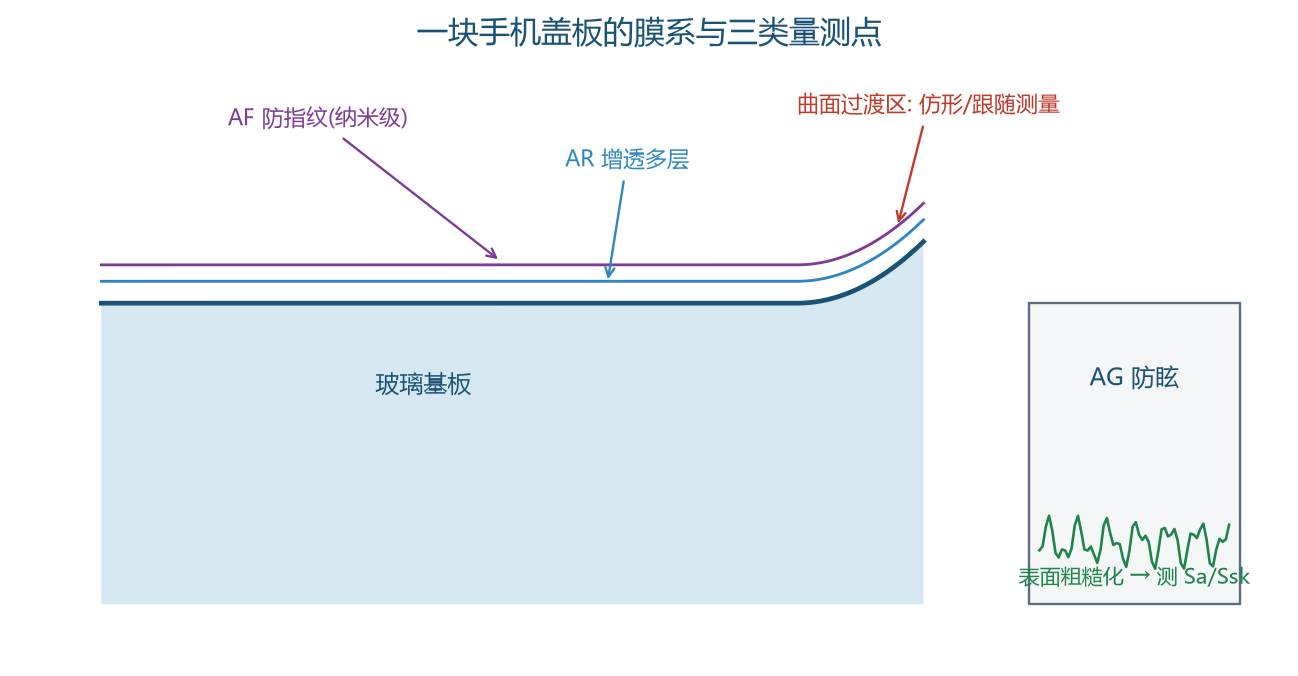
In product form, this scenario has spawned a dedicated category: the curved-surface film thickness gauge. The probe or sample stage has conformal capability, or a point spot with vision-based positioning is used, so that film thickness measurement on curved surfaces retains sub-nanometer accuracy. Acuitik's NS-Touch curved-surface film thickness gauge is a product designed for exactly this scenario, paired with the microscopic form factor (NS-Micro) to cover small-area measurement at punch holes and silk-screen regions.
AG roughness measurement is covered here as well: the Sa, Sz, and skewness Ssk of an anti-glare surface directly govern glare performance and the visual appearance of fingerprint residue; optical profilers (white-light interferometry or chromatic confocal) are the mainstay, with parameter definitions and filtering conditions in "A Primer on Surface Roughness Parameters". Putting film thickness and roughness into the same incoming and outgoing inspection specification is a common blind spot in cover-glass plants' metrology systems — often film thickness is under control while batch drift of the AG surface goes unwatched.
A final lesson from the consumer electronics industry: film stacks iterate fast in this market (new materials and new processes every year), so choose a vendor whose "software can keep up with film-stack changes". Materials-library updates, custom modeling, and the response speed of application engineers carry more weight in the cover glass industry than any single hardware specification.
About Acuitik
Acuitik specializes in optical precision measurement technology. Its core products are reflectance-based film thickness gauges, ellipsometers, and OEM film thickness sensors featuring "non-contact, non-destructive, sub-nanometer accuracy":
- Industrial film thickness measurement NS series: NS-20 manual, NS-30 automated Mapping, NS-Micro microscopic, NS-Touch curved-surface, NS-HR thick-film, NS-100 high-speed line-scan
- Research-grade measurement ES series: ES-Tenso ellipsometer, ES-Primo multi-wavelength ellipsometer (for ultrathin films and complex multilayers), plus the NS-Vista dual-channel and NS-Flex portable multimodal units
- OEM film thickness sensors: multi-point nanoscale film thickness, NS-HR thick-film, and NS-Micro microscopic sensor modules, supporting Modbus / OPC UA for integration with PLC and MES, with an SDK provided
The instruments are metrologically certified by the National Institute of Metrology of China and the Shanghai Institute of Measurement and Testing Technology, and Acuitik participated in drafting the group standard T/CIET 2298-2026 "Calibration Specification for Thin-Film Interference Film Thickness Measurement Systems". For more selection guides and application notes, please visit the Acuitik official website.