The three mainstream routes of optical thickness measurement — reflectance, ellipsometry, and white-light interferometry — are often placed into the same spec sheet and compared, from which someone concludes "which one is the most accurate." That comparison misleads. The three routes solve different problems, and the right question is "which one fits my film stack." This article offers as clean a division-of-labor framework as possible.
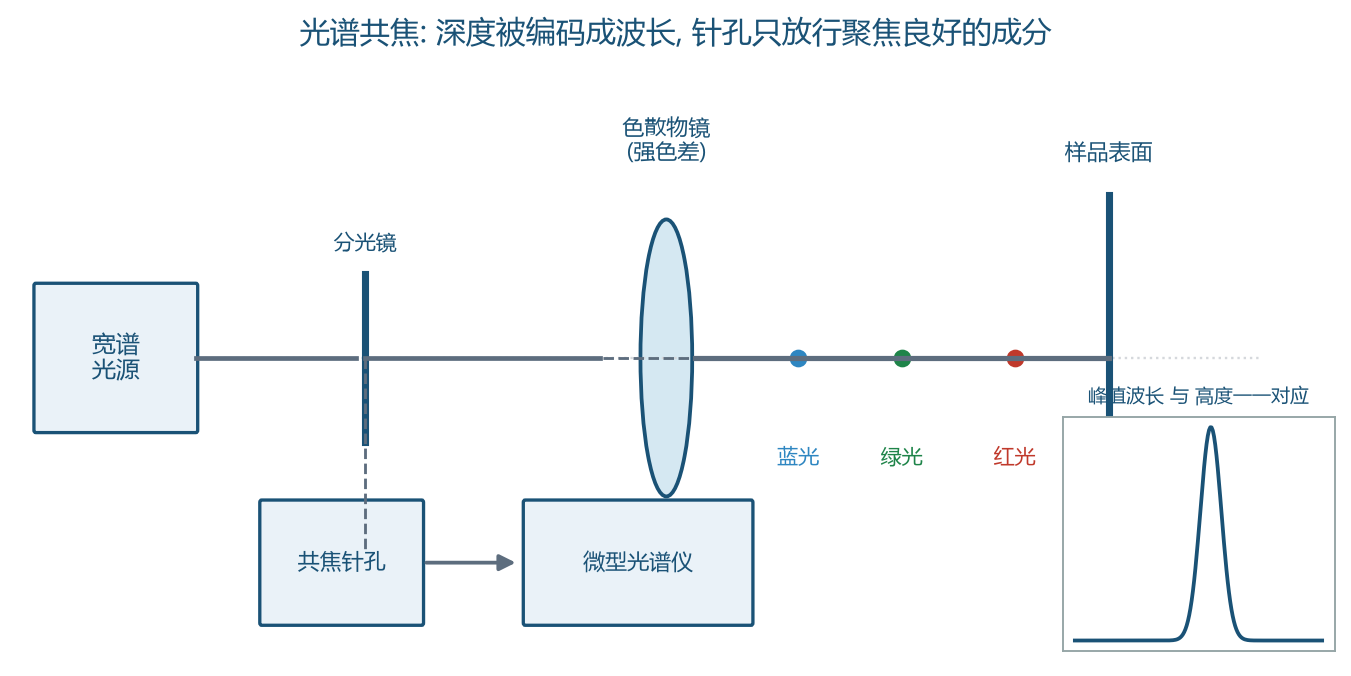
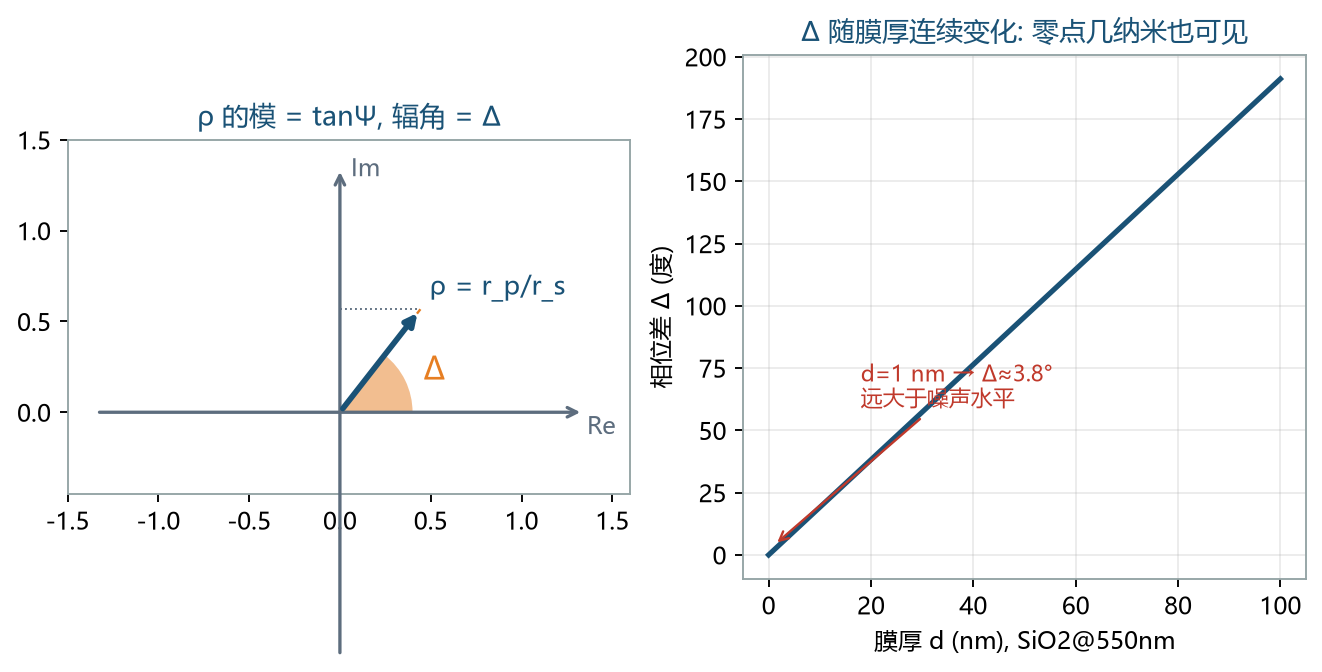
First, lay out the physical footing of each route. The reflectance route measures the interference oscillations of the reflectance spectrum; the thickness information sits in the arrangement of extrema. The ellipsometric route measures the change in polarization state (Ψ and Δ); the thickness information sits in the phase. White-light interferometry (WLI) is an interference microscope performing a vertical scan, finding the zero-order white-light interference position at every point to obtain surface topography directly — what it measures is essentially "height," and the thickness of a transparent film must be solved out of the height difference between its upper and lower surfaces.
| Dimension | Reflectance-based | Spectroscopic ellipsometry | White-light interferometry |
|---|---|---|---|
| Typical accuracy range | ±10 nm or 0.4% (whichever is larger; benchtop nominal) | Sub-nanometer down to the 0.01 nm level | Vertical resolution at the 0.1 nm level |
| Comfortable thickness range | About 50 nm–3 mm (depending on band configuration) | Sub-nanometer to several micrometers | Any topography; transparent film thickness from the µm scale up |
| Single-point speed | Milliseconds to seconds | Seconds | Seconds to minutes (area imaging) |
| Sample requirements | Transparent/semi-transparent, fairly smooth | Fairly smooth, modeling required | Friendly to optically rough surfaces |
| Weak points | No solution for opaque films; multilayers depend on priors | Costly; high modeling barrier | Absolute thickness needs a step or two-sided measurement |
| Price band | Low–mid | Mid–high | Mid–high |
Three clear ecological niches emerge from the table. The reflectance route is the top performer on speed and cost: millisecond single points, friendly benchtop pricing, maintenance-free — it carries a large share of routine monitoring of dielectric films and photoresist, at the cost of not reaching the sub-nanometer range and having no answer for opaque films. The ellipsometric route is the top performer on sensitivity and modeling depth: ultrathin films, optical constants, and complex multilayers are its territory, and angstrom-level control in advanced processes can only come from it, at the cost of price and a high software barrier. White-light interferometry is the "topography first" route: it measures the three-dimensional profile of an entire region, covering surface roughness, step heights, and film thickness (via upper/lower surface separation) in one instrument, and is especially friendly to rough and patterned surfaces, at the cost of absolute thickness accuracy limited by refractive index correction.
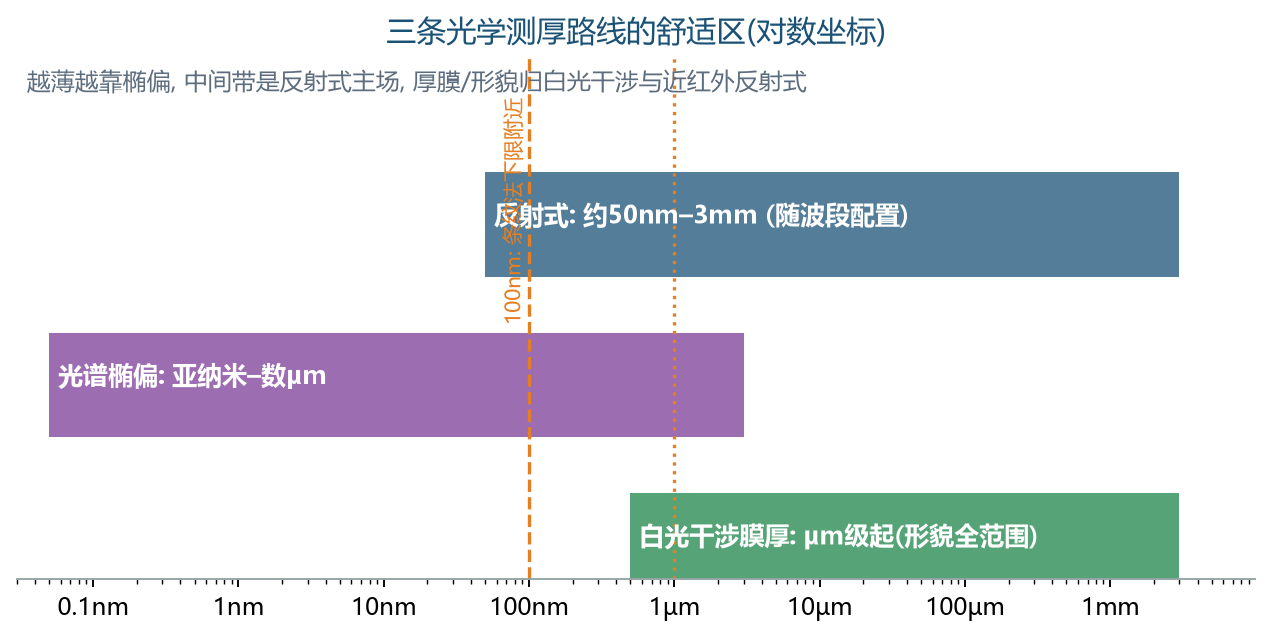
How to choose in the overlap zones? Three rules of thumb. Below 100 nm of thickness, prefer ellipsometry — the fringe method has no complete pair of extrema to work with (the principle is in "How Film Thickness Is Read Out"). If refractive index and extinction coefficient are deliverables (not just thickness), prefer ellipsometry. If the sample is rough or patterned, or surface roughness data must be delivered alongside, prefer white-light interferometry. In the remaining middle ground — transparent dielectric films from a few nanometers to a few micrometers, single layers or stacks with only a few layers, with fast inline results required — the reflectance route is usually the most economical choice, which is also why it has the largest installed volume in the photovoltaic, coating, and cover-glass industries.
The three brothers are not substitutes for one another. Acuitik built the reflectance route (NS series) and ellipsometry (ES series) as two product lines of one company for exactly this reason: as film stacks go from thick to thin and processes move from R&D to volume production, the route you need will change — a supplier who can change routes with you saves far more effort than changing suppliers every time.
About Acuitik
Acuitik specializes in optical precision measurement technology. Its core products are reflectance-based film thickness gauges, ellipsometers, and OEM film thickness sensors featuring "non-contact, non-destructive, sub-nanometer accuracy":
- Industrial film thickness measurement NS series: NS-20 manual, NS-30 automated Mapping, NS-Micro microscopic, NS-Touch curved-surface, NS-HR thick-film, NS-100 high-speed line-scan
- Research-grade measurement ES series: ES-Tenso ellipsometer, ES-Primo multi-wavelength ellipsometer (for ultrathin films and complex multilayers), plus the NS-Vista dual-channel and NS-Flex portable multimodal units
- OEM film thickness sensors: multi-point nanoscale film thickness, NS-HR thick-film, and NS-Micro microscopic sensor modules, supporting Modbus / OPC UA for integration with PLC and MES, with an SDK provided
The instruments are metrologically certified by the National Institute of Metrology, China (NIM) and the Shanghai Institute of Measurement and Testing Technology (SIMT), and Acuitik participated in drafting the group standard T/CIET 2298-2026 "Calibration Specification for Thin-Film Interference Film Thickness Measurement Systems". For more selection guides and application notes, please visit the Acuitik official website.