Every performance figure of an ellipsometer ultimately lands on two Greek letters: Ψ (Psi) and Δ (Delta). This article explains what they are, why they are defined this way, and why this definition makes ellipsometric measurement so sensitive.
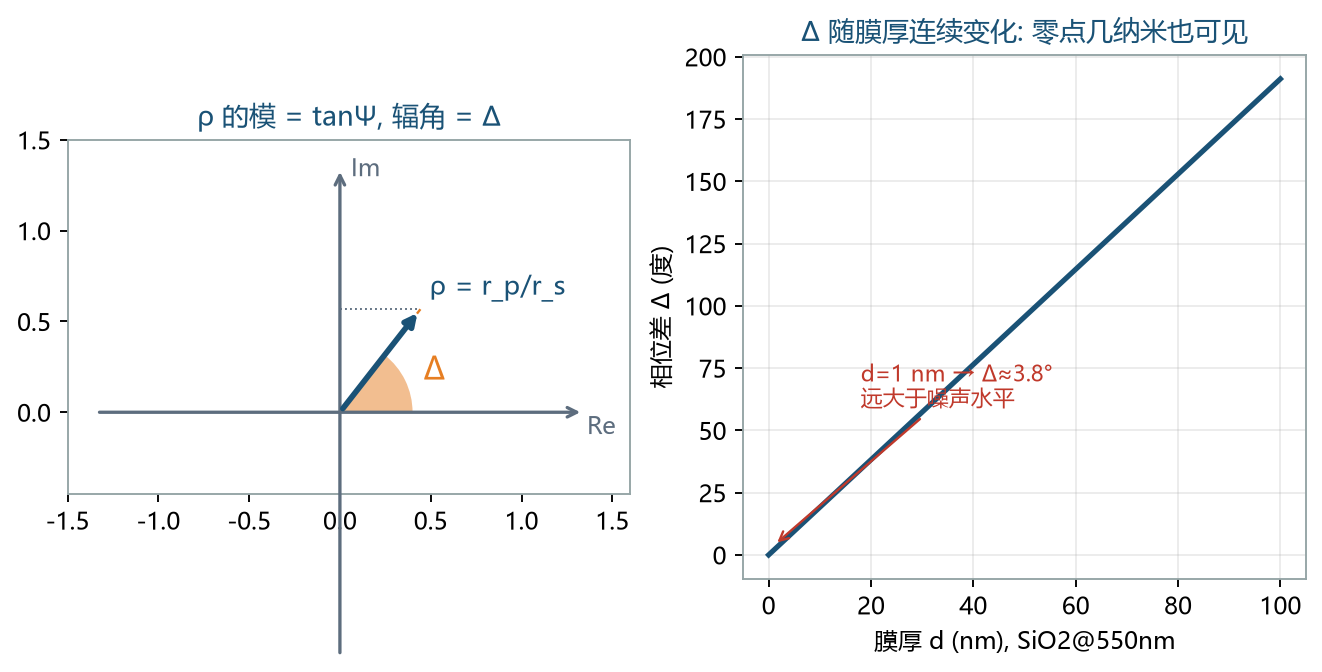
When light reflects off a thin film, the p-polarized and s-polarized components each acquire a complex-amplitude reflection coefficient, r_p and r_s. The pivotal move of ellipsometry is to take their ratio: ρ = r_p / r_s. Any complex number can be written in magnitude and argument, so ρ = tanΨ · e^(iΔ), with the magnitude expressed by Ψ and the argument being Δ. In other words, Ψ describes how much the amplitude ratio of the two components changed on reflection, and Δ describes how much their phase difference changed. The information of the entire film stack — thickness, the n and k of every layer, interface roughness — is compressed into these two numbers.
Why is this definition sensitive? An analogy: to judge the height of a water surface, one way is to read a level gauge; another is to drop a ripple onto the water and time when it reaches a fixed position. The advantage of the second way is that even a slight change in the water level moves the ripple's arrival time — you have converted an "amplitude problem" into a "phase problem." Ellipsometric measurement belongs to the second kind: Δ is a phase quantity, so a thickness change of even a few tenths of a nanometer moves Δ, and modern optics can read phase with extraordinary finesse. That is where sub-nanometer sensitivity comes from.
But a single (Ψ, Δ) point carries limited information after all. One wavelength at one angle yields only two real numbers — barely enough to solve the thickness and refractive index of a single layer, and out of the question for multilayers. Forty years of ellipsometer evolution have revolved around one direction: get more data. Spectroscopy gives a set of (Ψ, Δ) at every wavelength, a two-orders-of-magnitude increase in information, and spectroscopic ellipsometry (SE) became the mainstream accordingly; multi-angle measurement adds more data sets from different angles of incidence; Mueller-matrix ellipsometry goes a step further and measures all 16 elements of the sample's transformation of polarized light, serving anisotropic and deep-subwavelength structures.
With more data comes more inversion power. This is also the software divide between ellipsometry and reflectance: ellipsometric fitting is almost purely model-driven — layer structure, dispersion, and roughness must all be modeled explicitly, and parameter correlation analysis is daily homework — while the reflectance route still has the fringes as "direct evidence" to fall back on. The two routes read data with different postures; a later article, "How to Read Goodness of Fit," will expand on this.
One final reminder for users: Ψ and Δ are the raw quantities, wavelength by wavelength and angle by angle, while the thickness and refractive index shown on the instrument interface are fitting products. When reviewing anomalous data, go back to how well the modeled (Ψ, Δ) curves and spectra match the measurement — that locates the problem far better than staring at the thickness number alone.
About Acuitik
Acuitik specializes in optical precision measurement technology. Its core products are reflectance-based film thickness gauges, ellipsometers, and OEM film thickness sensors featuring "non-contact, non-destructive, sub-nanometer accuracy":
- Industrial film thickness measurement NS series: NS-20 manual, NS-30 automated Mapping, NS-Micro microscopic, NS-Touch curved-surface, NS-HR thick-film, NS-100 high-speed line-scan
- Research-grade measurement ES series: ES-Tenso ellipsometer, ES-Primo multi-wavelength ellipsometer (for ultrathin films and complex multilayers), plus the NS-Vista dual-channel and NS-Flex portable multimodal units
- OEM film thickness sensors: multi-point nanoscale film thickness, NS-HR thick-film, and NS-Micro microscopic sensor modules, supporting Modbus / OPC UA for integration with PLC and MES, with an SDK provided
The instruments are metrologically certified by the National Institute of Metrology, China (NIM) and the Shanghai Institute of Measurement and Testing Technology (SIMT), and Acuitik participated in drafting the group standard T/CIET 2298-2026 "Calibration Specification for Thin-Film Interference Film Thickness Measurement Systems". For more selection guides and application notes, please visit the Acuitik official website.