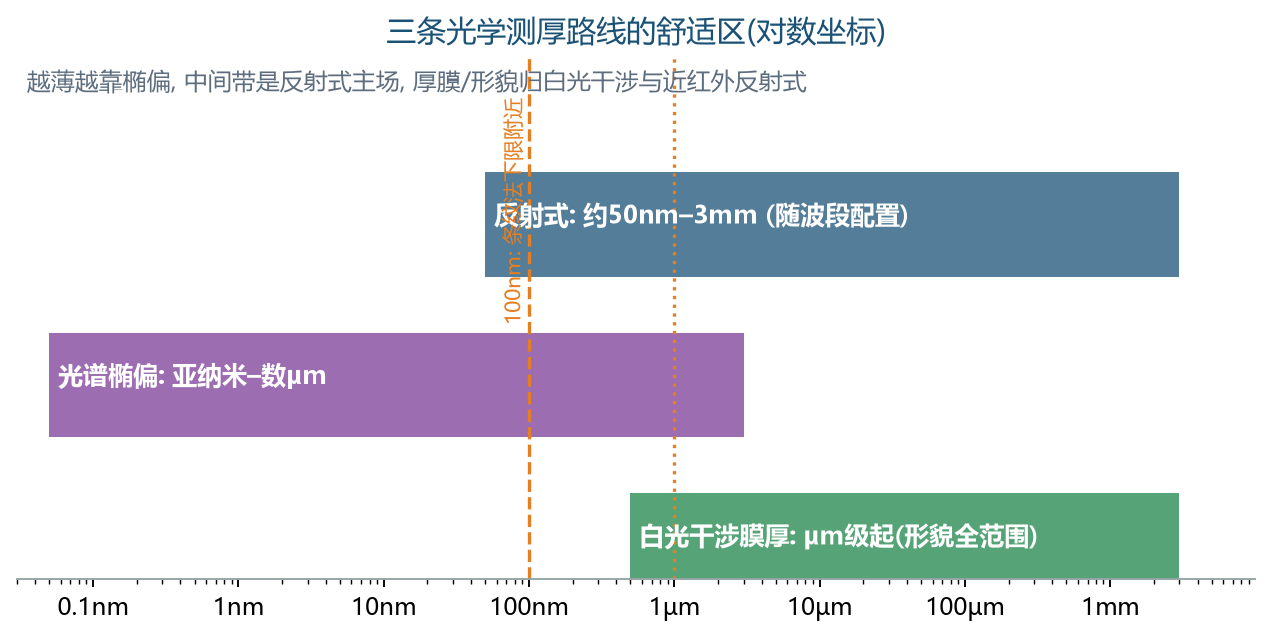
Both are non-contact optical ways of measuring films, but the ellipsometer and the reflectance-based film thickness gauge are two parallel technology routes. They watch the same physical process — light reflecting off a thin film — yet they look at different properties. The reflectance route looks at intensity (which wavelengths reflect more, which less); the ellipsometer looks at polarization (how reflection changes the polarization state of the light).
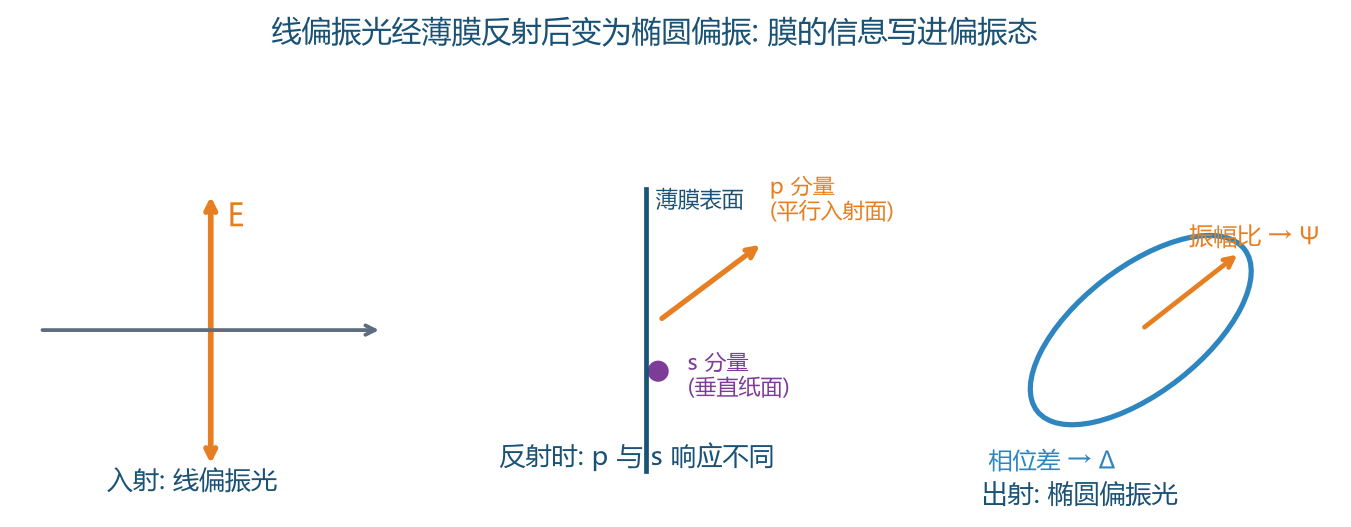
Polarization is the third dimension of light. Beyond intensity, light has a vibration direction: linear, circular, and elliptical polarization. The key fact is that when light reflects at an interface, the reflection coefficients of the polarization component parallel to the plane of incidence (p light) and the component perpendicular to it (s light) are different, and the difference is directly tied to film thickness and the optical constants of the material. A linearly polarized beam striking a thin film generally returns as elliptically polarized light — hence the name ellipsometer.
In 1887, the German physicist Drude built the mathematical framework of this theory, compressing the polarization change caused by reflection into two parameters: Ψ (the change in the amplitude ratio of the two polarization components) and Δ (the change in the phase difference between them). More than 130 years on, every form the ellipsometer has taken — manual, automated, spectroscopic, multi-angle — has been about measuring these two numbers more precisely and more quickly.
Why is it especially sensitive to ultrathin films? The intuitive explanation: phase is a quantity that can vary continuously through zero, so even when the film is only a few tenths of a nanometer thick, the phase difference between the p and s components shifts by a perceptible amount; intensity-type measurements, by contrast, are intrinsically weak when the film is extremely thin. Ellipsometer sensitivity can therefore reach into the sub-nanometer range — its core advantage over other optical techniques. This is also what underpins angstrom-level control of EOT (equivalent oxide thickness) in advanced semiconductor manufacturing.
The price of the ellipsometer is just as clear: it demands more of both sample and model. Fitting requires a complete optical model (layer structure, dispersion models, roughness layers), the method is sensitive to surface uniformity, and both instrument price and the software learning curve sit above the reflectance route. The rough division of labor: measuring a dielectric film a few micrometers thick, reflectance is fast and economical; measuring ultrathin films of a few nanometers, extracting optical constants, solving complex multilayers — the ellipsometer is the proper answer.
The two routes are not competitors; they are relays. Acuitik's research-grade product line includes both reflectance-based film thickness gauges and ellipsometers, and the ES-Primo is built for multi-wavelength measurement, officially positioned for ultrathin films and complex multilayer structures. Starting with reflectance to build intuition for film stacks, then moving up to ellipsometry for sub-nanometer problems, is the natural path for most laboratories.
About Acuitik
Acuitik specializes in optical precision measurement technology. Its core products are reflectance-based film thickness gauges, ellipsometers, and OEM film thickness sensors featuring "non-contact, non-destructive, sub-nanometer accuracy":
- Industrial film thickness measurement NS series: NS-20 manual, NS-30 automated Mapping, NS-Micro microscopic, NS-Touch curved-surface, NS-HR thick-film, NS-100 high-speed line-scan
- Research-grade measurement ES series: ES-Tenso ellipsometer, ES-Primo multi-wavelength ellipsometer (for ultrathin films and complex multilayers), plus the NS-Vista dual-channel and NS-Flex portable multimodal units
- OEM film thickness sensors: multi-point nanoscale film thickness, NS-HR thick-film, and NS-Micro microscopic sensor modules, supporting Modbus / OPC UA for integration with PLC and MES, with an SDK provided
The instruments are metrologically certified by the National Institute of Metrology, China (NIM) and the Shanghai Institute of Measurement and Testing Technology (SIMT), and Acuitik participated in drafting the group standard T/CIET 2298-2026 "Calibration Specification for Thin-Film Interference Film Thickness Measurement Systems". For more selection guides and application notes, please visit the Acuitik official website.