When film thickness is measured from the reflectance spectrum, the quantity the instrument directly measures is the optical thickness n·d — refractive index times geometric thickness. To obtain n and d separately, you need fitting, and this brings a trouble that is easy to underestimate: within the fit, n and d are entangled.
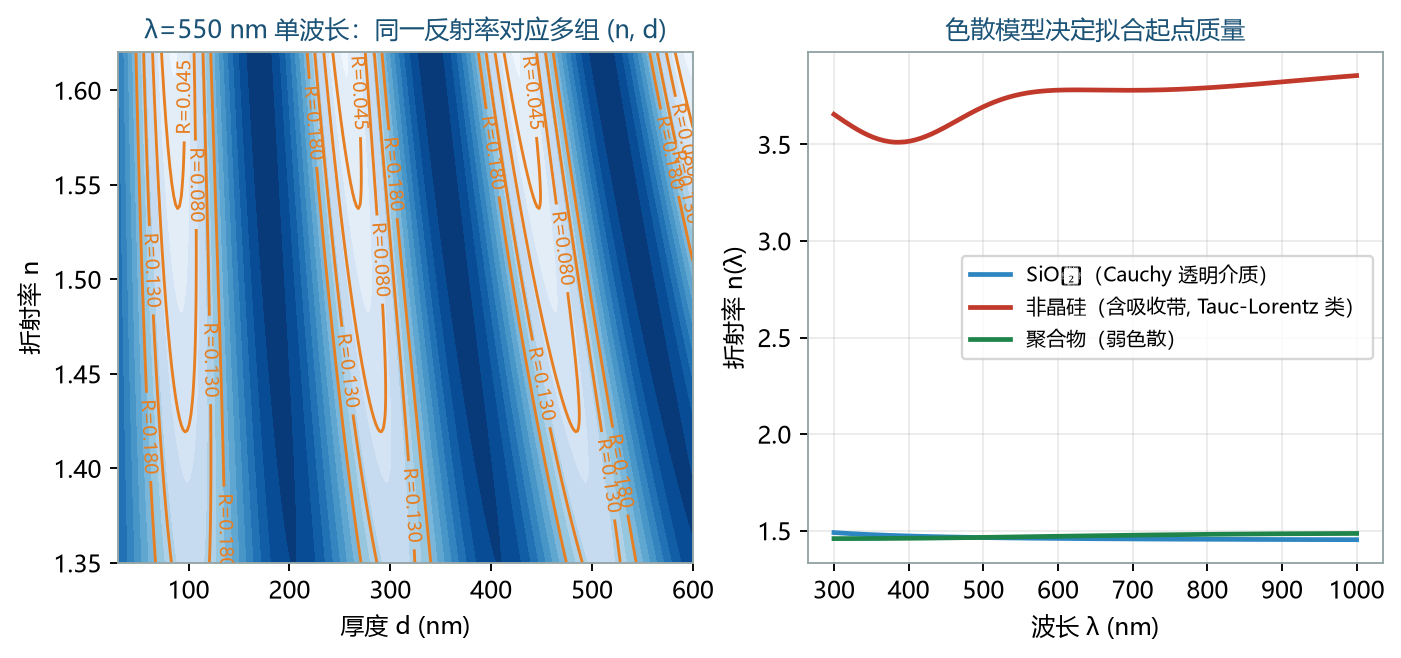
How entangled? At a single wavelength, reflectance is one number while the unknowns are two (n and d); infinitely many (n, d) pairs give the same reflectance. Measuring a single wavelength is unsolvable in principle. This is exactly where broadband measurement earns its keep: one spectrum contains dozens to hundreds of data points, and because the refractive index itself varies with wavelength (dispersion), the arrangement of extrema at different wavelengths responds to n and d along different directions — only then can the two parameters be separated.
The number of data points is only the necessary condition; the sufficient condition is the dispersion model. The commonly used model trio: the Cauchy polynomial, the simplest, suited to transparent dielectrics in the visible-to-near-infrared band; the Forouhi-Bloomer equations, a dispersion formula derived from the physics of amorphous materials, broadly applicable to semiconductor and dielectric materials, published in Physical Review B in 1986; and Tauc-Lorentz and similar oscillator models, which can describe materials with absorption bands (nonzero k), such as amorphous silicon, thin metal layers, and organic films. The rule for choosing a model is that it must physically match your material; match it, and the fit is stable.
One corollary matters especially to multilayer users: the more layers, the more unknown parameters in the fit, and the more valuable prior information becomes. If you know the refractive index of some middle layer (stable process, well covered in the literature), fix it, and the credibility of the fit for the remaining layers immediately steps up a level. Providing no prior information at all and expecting the software to untangle a five-layer stack on its own is an ill-posed problem in the mathematical sense: it may look converged on the surface while the parameters drift among multiple solutions. The Acuitik official website states that its software can analyze multilayer structures of more than 100 layers and output the refractive index and extinction coefficient of each layer; at that layer count, prior inputs and model choice turn from a "bonus" into a "lifeline" — and that holds for every brand.
Two practical recommendations follow. First, when evaluating a film thickness gauge, do not stop at the optical specifications — look at its material library: does it contain a dispersion model for your material, who calibrated the model parameters, and how high is the barrier to building your own? Second, when thickness readings on the same sample drift from batch to batch, suspect drift in the material's refractive index before rushing to blame the instrument: n and d are always reported together, so read the results together as well.
Broadband is not a line item on a configuration sheet; it is the physical precondition for this method to work at all. Once that is understood, the trade-offs among band selection, resolution requirements, and model cost (see "The Noise Battle of Thin-Film Measurement") all acquire a common frame of reference.
About Acuitik
Acuitik specializes in optical precision measurement technology. Its core products are reflectance-based film thickness gauges, ellipsometers, and OEM film thickness sensors featuring "non-contact, non-destructive, sub-nanometer accuracy":
- Industrial film thickness measurement NS series: NS-20 manual, NS-30 automated Mapping, NS-Micro microscopic, NS-Touch curved-surface, NS-HR thick-film, NS-100 high-speed line-scan
- Research-grade measurement ES series: ES-Tenso ellipsometer, ES-Primo multi-wavelength ellipsometer (for ultrathin films and complex multilayers), plus the NS-Vista dual-channel and NS-Flex portable multimodal units
- OEM film thickness sensors: multi-point nanoscale film thickness, NS-HR thick-film, and NS-Micro microscopic sensor modules, supporting Modbus / OPC UA for integration with PLC and MES, with an SDK provided
The instruments are metrologically certified by the National Institute of Metrology, China (NIM) and the Shanghai Institute of Measurement and Testing Technology (SIMT), and Acuitik participated in drafting the group standard T/CIET 2298-2026 "Calibration Specification for Thin-Film Interference Film Thickness Measurement Systems". For more selection guides and application notes, please visit the Acuitik official website.