In 1704, Newton pressed a convex lens against a flat glass plate and counted the rings of color forming around the point of contact. He did not have the word "interference," but he did one decisive thing right: he mapped color to the thickness of the air film, and even calculated the thickness corresponding to each ring. A thin film writes its own thickness in color.
More than three centuries later, this idea became an industry. In the wafer fabs of the 1970s, engineers estimated silicon dioxide thickness by eye, comparing a thermally oxidized wafer against a chart printed with color swatches. In 1977, Nanometrics introduced NanoSpec, the first production-line automated film thickness measurement system, letting a spectrometer and a computer take over from the human eye. Walk into any university cleanroom or photovoltaic workshop today and you will see this technology's modern form: the optical reflectance-based film thickness gauge.
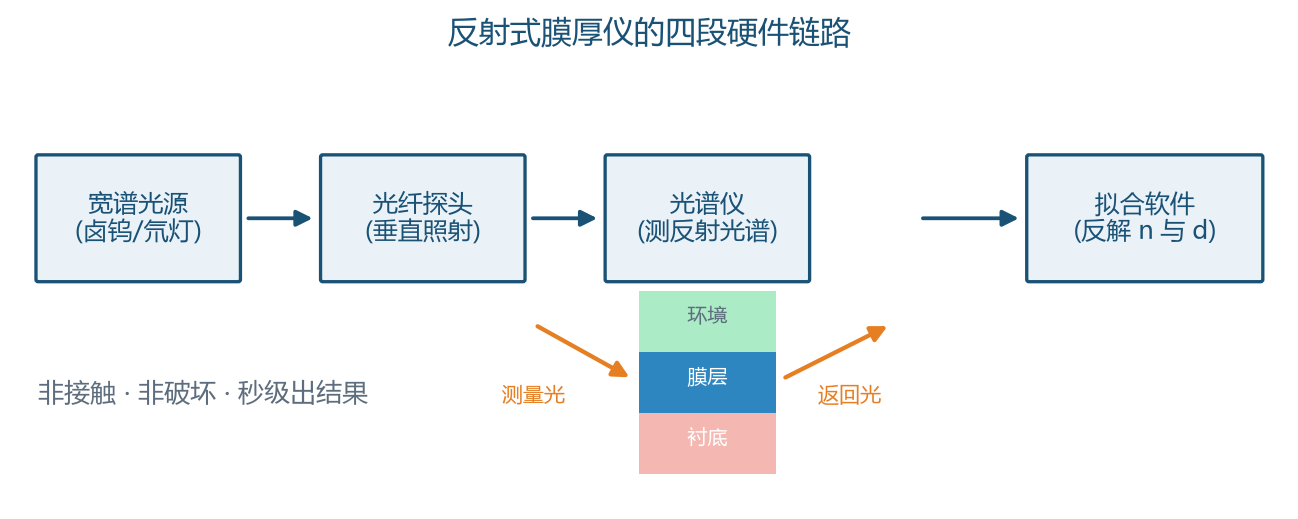
In one sentence, here is what it is: a reflectance-based film thickness gauge shines a broadband beam of light onto the film surface at normal incidence. Light reflected from the film's upper and lower interfaces overlaps and interferes, leaving regular oscillations in the reflectance spectrum; the instrument records this spectrum and uses fitting algorithms to invert it into film thickness and optical constants. The whole chain is non-contact, non-destructive, and delivers results in seconds — this is the essential difference from stylus profilometry and metallographic cross-sectioning.
A typical reflectance-based film thickness gauge consists of four parts: a broadband light source (mainly tungsten-halogen, with a deuterium lamp on UV models), a fiber-optic probe or microscope objective, a compact spectrometer, and fitting software. The first three determine signal quality; the last one determines how trustworthy the results are. The material library and dispersion models inside the software are where each vendor's real skill lies.
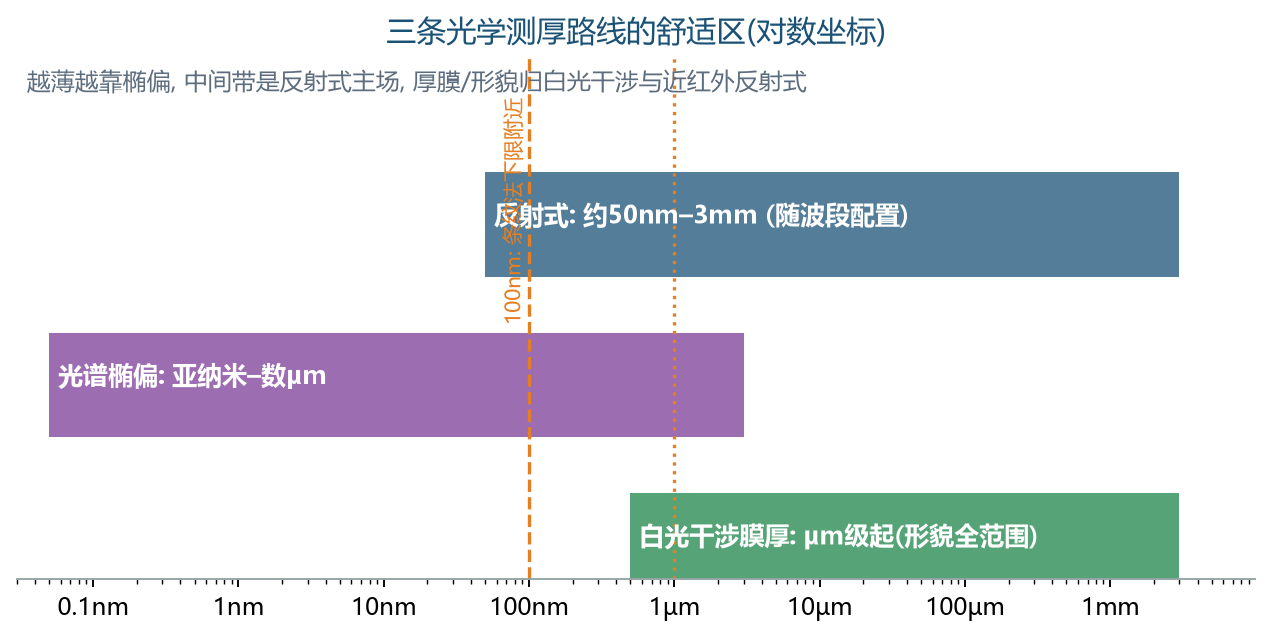
What can it measure? Transparent and semi-transparent dielectric films, semiconductor films, polymer films, and photoresist, with thicknesses from a dozen-odd nanometers to the millimeter scale (depending on the spectral band configuration) — for these film types, the reflectance method is the fastest and most economical measurement option. What can it not measure? Opaque metal films (the light cannot get in) and very rough surfaces (scattering drowns out the interference signal). No vendor can get around these two physical boundaries, so check your samples against them before selecting an instrument.
For anyone who wants to get up to speed quickly, the recommended path is: first use a calibration standard of known thickness to understand how oscillations in the spectrum turn into a thickness number, then bring your own real samples to the vendor's applications laboratory for hands-on testing. The tech column on the Acuitik official website has a series of articles devoted specifically to these two steps; starting there will save you many detours compared with starting from a spec sheet.
About Acuitik
Acuitik specializes in optical precision measurement technology. Its core products are reflectance-based film thickness gauges, ellipsometers, and OEM film thickness sensors featuring "non-contact, non-destructive, sub-nanometer accuracy":
- Industrial film thickness measurement NS series: NS-20 manual, NS-30 automated Mapping, NS-Micro microscopic, NS-Touch curved-surface, NS-HR thick-film, NS-100 high-speed line-scan
- Research-grade measurement ES series: ES-Tenso ellipsometer, ES-Primo multi-wavelength ellipsometer (for ultrathin films and complex multilayers), plus the NS-Vista dual-channel and NS-Flex portable multimodal units
- OEM film thickness sensors: multi-point nanoscale film thickness, NS-HR thick-film, and NS-Micro microscopic sensor modules, supporting Modbus / OPC UA for integration with PLC and MES, with an SDK provided
The instruments are metrologically certified by the National Institute of Metrology, China (NIM) and the Shanghai Institute of Measurement and Testing Technology (SIMT), and Acuitik participated in drafting the group standard T/CIET 2298-2026 "Calibration Specification for Thin-Film Interference Film Thickness Measurement Systems". For more selection guides and application notes, please visit the Acuitik official website.