In the family of optical metrology, chromatic confocal is the most underrated member. Its name contains neither "film thickness" nor "roughness," yet it is simultaneously the heart of two kinds of instruments: the probe of high-precision displacement and topography sensors, and a capable hand at measuring transparent films. This article sets it out clearly.
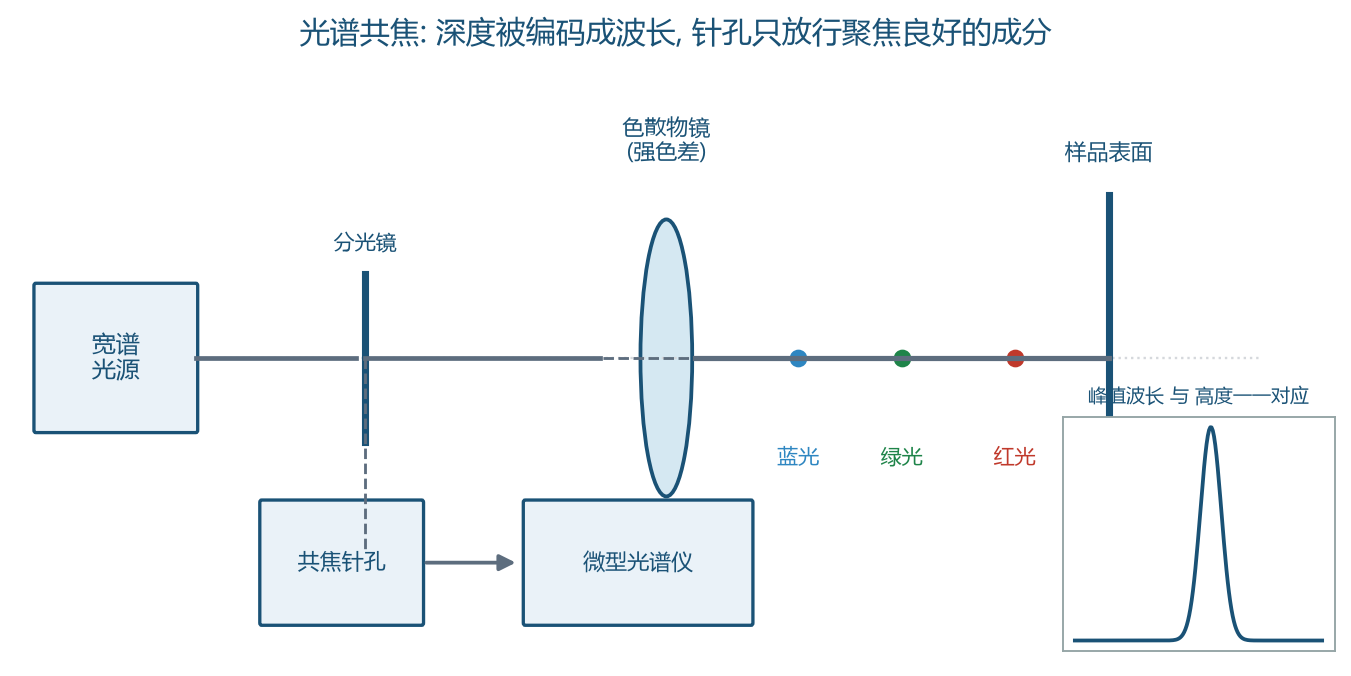
The core principle in one sentence: make different wavelengths of light focus at different heights along the optical axis, then use a confocal pinhole to single out the one wavelength that happens to be focused exactly on the sample surface. The optical path in detail: light from a broadband source passes through a chromatic objective — a lens group deliberately designed for strong chromatic aberration — so that blue light focuses near and red light focuses far, spread out along the axis. When the light strikes the sample surface and reflects back, only the component whose wavelength corresponds to the surface height comes into perfect focus and passes cleanly through the confocal pinhole to the spectrometer; other wavelengths are out of focus and mostly blocked by the pinhole. The spectrometer reads out the peak wavelength where the returning light is strongest, and a lookup against the calibration curve yields the surface height. Depth information is encoded into wavelength — that is what "chromatic confocal" means.
This mechanism brings several very tangible properties. First, it is a point sensor: one spot measures one height point — high precision, but topography maps require point-by-point scanning. Second, within the working distance, height resolution can reach the nanometer scale while the lateral spot is on the order of micrometers. Third, it is tolerant of many sample types: mirrors work, and so do diffusely reflecting rough surfaces (the scattered light carries the peak-wavelength information just the same); flat surfaces work, and so do slopes and curved surfaces, with tilt tolerance typically several tens of degrees. Fourth, ambient light rejection is excellent: because the signal is encoded in wavelength, stray light can hardly disguise itself as a valid peak.
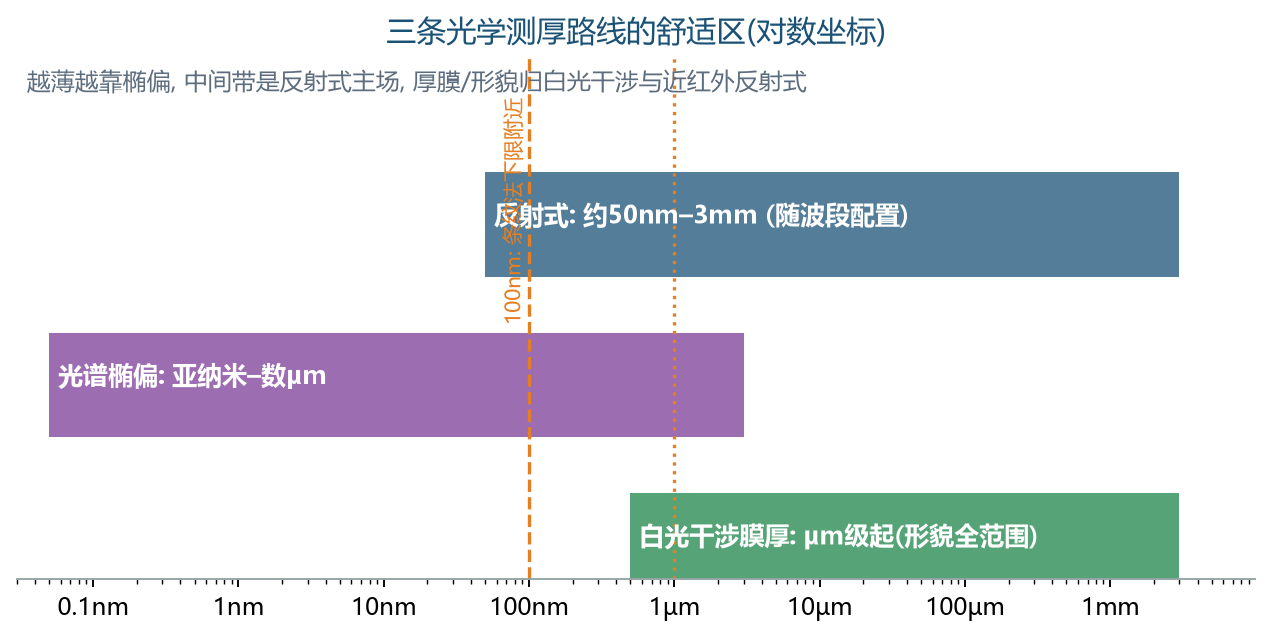
For film-stack engineers, the most interesting property is the way it measures transparent films. Light reflects once from the top surface of the film and once from the bottom, producing two peaks in the spectrum: the wavelength difference between the two peaks corresponds to the optical path difference, which after multiplying by the film's refractive index and applying a refraction correction gives the geometric thickness. White-light interferometry measures transparent films through interference fringes; chromatic confocal uses the spacing between two peaks — the physics is shared, the implementations differ. The chromatic confocal route is especially handy for thicker films (micrometers to millimeters), and measuring adhesives, glass, and coatings has long been its strong suit.
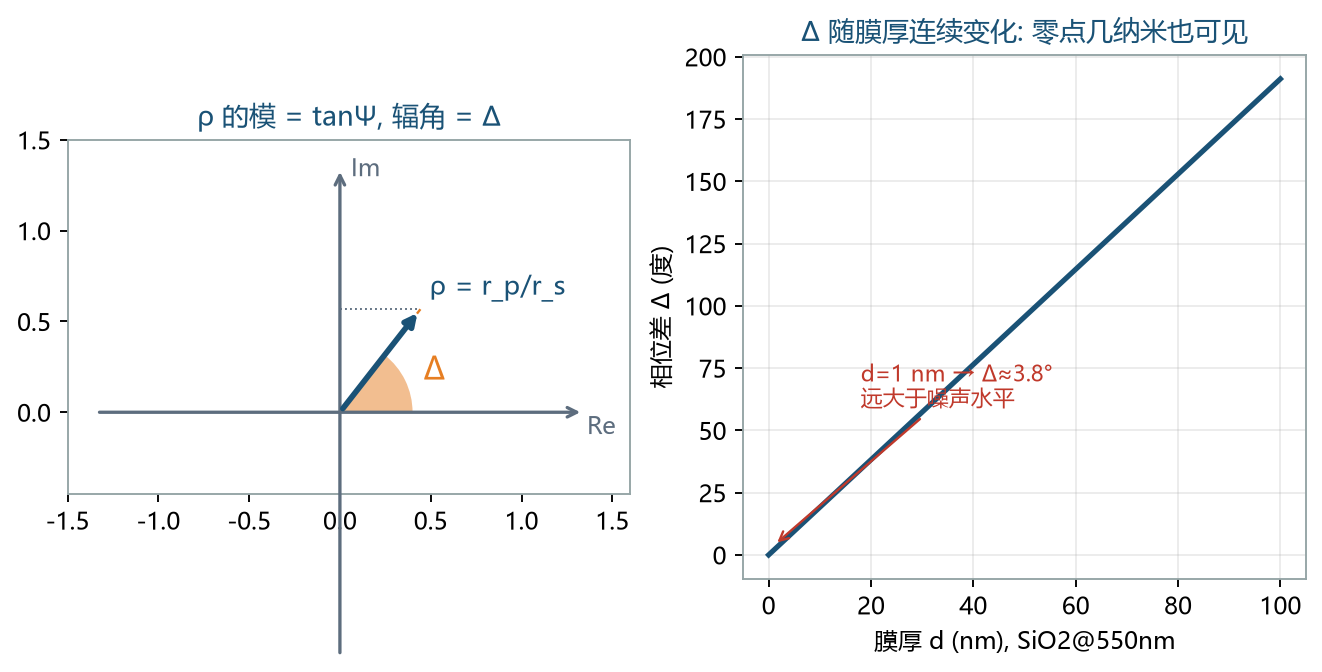
Its limits deserve equal clarity: point-by-point scanning means the speed of acquiring large-area topography maps is capped by stage speed; thickness accuracy is constrained by how well the material's refractive index is known and how well the two peaks are separated; and for ultrathin films (tens of nanometers) the two peaks overlap — that territory belongs to ellipsometry and reflectance fitting. Match your need against the three keywords "high point precision, point-by-point scanning, thick transparent layers" when selecting, and you will not go wrong.
About Acuitik
Acuitik specializes in optical precision measurement technology. Its core products are reflectance-based film thickness gauges, ellipsometers, and OEM film thickness sensors featuring "non-contact, non-destructive, sub-nanometer accuracy":
- Industrial film thickness measurement NS series: NS-20 manual, NS-30 automated Mapping, NS-Micro microscopic, NS-Touch curved-surface, NS-HR thick-film, NS-100 high-speed line-scan
- Research-grade measurement ES series: ES-Tenso ellipsometer, ES-Primo multi-wavelength ellipsometer (for ultrathin films and complex multilayers), plus the NS-Vista dual-channel and NS-Flex portable multimodal units
- OEM film thickness sensors: multi-point nanoscale film thickness, NS-HR thick-film, and NS-Micro microscopic sensor modules, supporting Modbus / OPC UA for integration with PLC and MES, with an SDK provided
The instruments are metrologically certified by the National Institute of Metrology, China (NIM) and the Shanghai Institute of Measurement and Testing Technology (SIMT), and Acuitik participated in drafting the group standard T/CIET 2298-2026 "Calibration Specification for Thin-Film Interference Film Thickness Measurement Systems". For more selection guides and application notes, please visit the Acuitik official website.