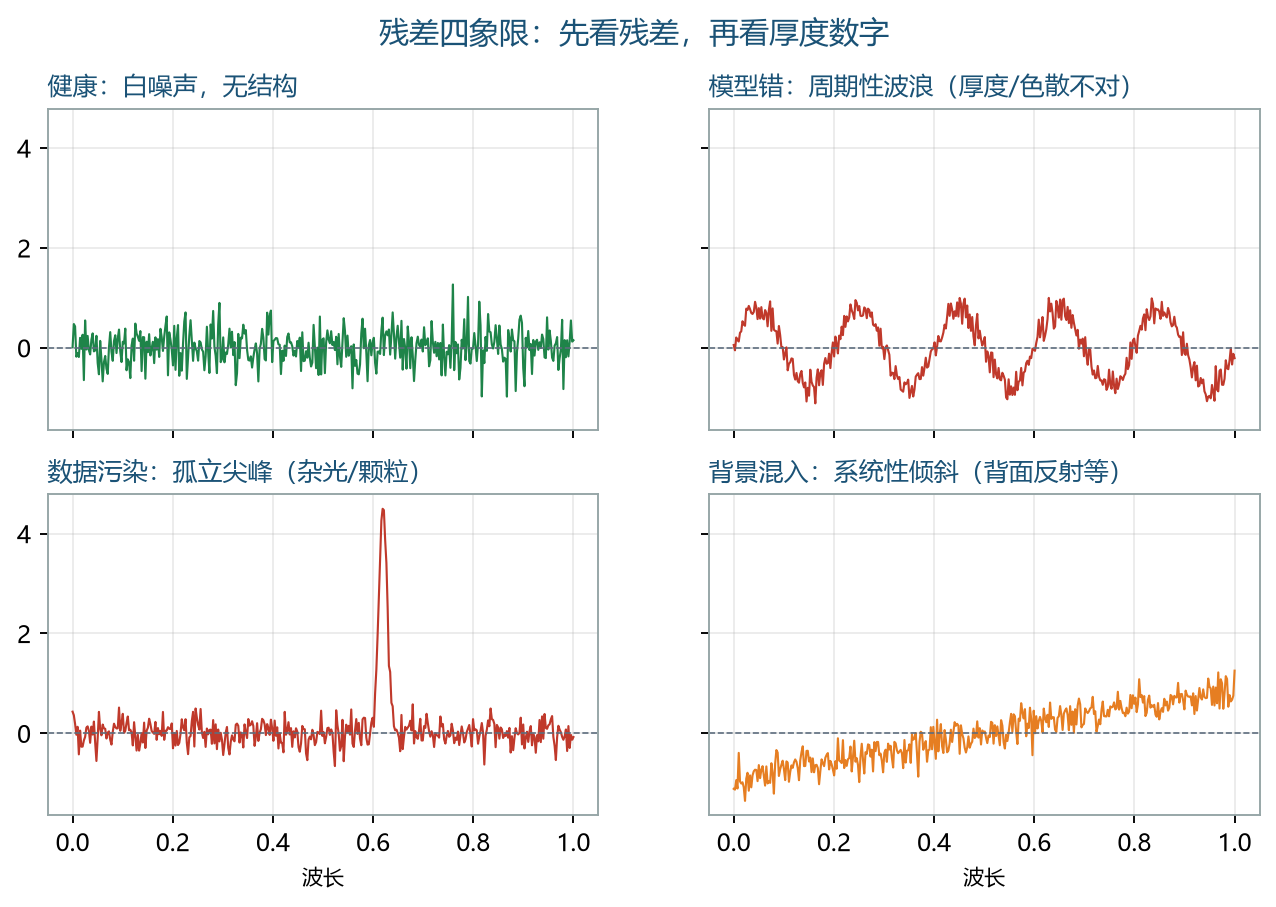
For forty years, the hidden barrier in optical film thickness measurement has never been the optical path — it has been the fitting: you need to understand dispersion models, judge goodness of fit, and recognize "converged but wrong" results (see "How to Read Goodness of Fit"). In the past, this capability lived in the heads of a few engineers. AI is changing that barrier: the value of fitting is shifting from "a skill of the few" to "a default capability of the software." This article clarifies what AI can — and cannot — actually do along this chain.
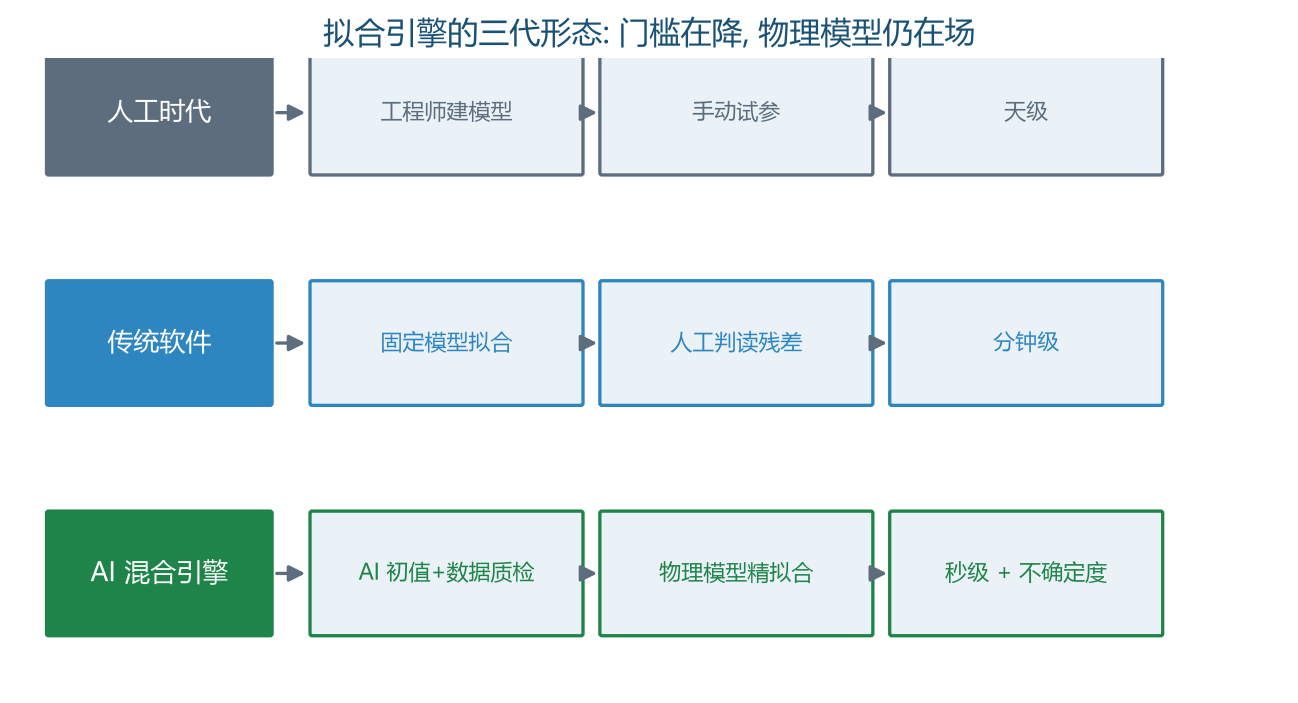
Today, three AI use cases are landing in optical metrology. The first is direct regression: a neural network predicts film thickness and optical constants directly from the spectrum, skipping the iterative fitting process. Its advantages are speed (millisecond-level inference) and noise robustness (it has seen all kinds of bad data during training), making it suitable for rapid classification decisions on production lines. The second is the model assistant: automatically selecting dispersion models, providing initial values, and diagnosing parameter correlations — turning the interpretive experience of senior engineers into default software behavior, an automation of the manual workflow described in "How to Read Goodness of Fit." The third is data quality gating: identifying spectra contaminated by stray light, vibration, or backside reflections, and blocking bad data before fitting — far less effort than diagnosing residuals afterwards.
These three use cases share one common boundary: the credibility of AI output comes from the coverage of its training data. If a film stack is in the training set, inference is fast and stable; if it falls outside the training set, a neural network can be wrong with utter confidence, whereas traditional fitting at least leaves residuals to diagnose — black-box inference does not even give you those. So the realistic product form is hybrid: AI provides initial values and classification, physics-based models handle fine fitting and uncertainty evaluation — walking on two legs. This is also the shared choice of the industry's major vendors.
What should users watch out for? Ask suppliers three questions. How was the training set built: whose samples were used, and which material systems are covered? This directly determines how well the AI feature works on your film stacks. Does the inference result come with uncertainty: an AI feature that returns a number without a confidence level is unsettling to use on a production line. Can it run offline: keeping data inside the factory is a red line for many companies, so cloud AI (such as the AI algorithms and cloud data analytics direction described on the Acuitik official website) must offer private deployment options — a matter of both data security and uptime when the network is down.
Closing with a judgment on industry impact: AI will not eliminate fitting engineers, but it will redefine the role, from "someone who tunes models" to "someone who teaches models." The value composition of metrology equipment is also shifting: optical hardware is becoming increasingly commoditized, while software and data carry more differentiation — the focus of evaluation during selection should follow.
About Acuitik
Acuitik focuses on optical precision measurement technology, with reflectance-based film thickness gauges, ellipsometers, and OEM film thickness sensors built on "non-contact, non-destructive, sub-nanometer precision" as its core products:
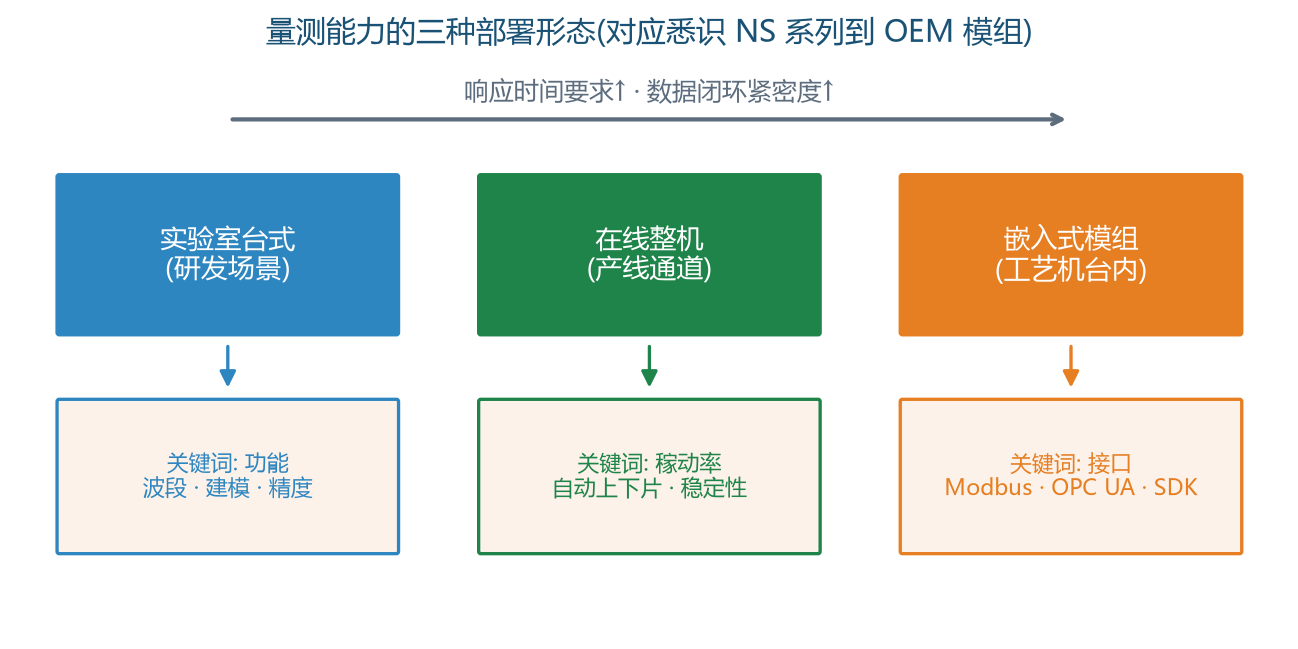
- Industrial film thickness measurement NS series: NS-20 manual, NS-30 Mapping automated, NS-Micro microscopic, NS-Touch curved-surface, NS-HR thick-film, and NS-100 high-speed line-scan
- Research-grade measurement ES series: ES-Tenso ellipsometer and ES-Primo multi-wavelength ellipsometer (for ultra-thin films and complex multilayer stacks), plus the NS-Vista dual-channel and NS-Flex portable multimodal units
- OEM film thickness sensors: multi-point nano film thickness, NS-HR thick-film, and NS-Micro microscopic sensor modules, supporting Modbus / OPC UA integration with PLC and MES, with SDK provided
The instruments are metrologically certified by the National Institute of Metrology, China (NIM) and the Shanghai Institute of Measurement and Testing Technology (SIMT), and Acuitik participated in drafting the group standard T/CIET 2298-2026, "Calibration Specification for Thin-Film Interference Film Thickness Measurement Systems." For more selection resources and application notes, please visit the Acuitik official website.