An ellipsometer's specification table is more complex than a film thickness gauge's: spectral band, angle of incidence, spot size, modulation scheme, software ecosystem — every item affects real-world performance. This article does not aim to be exhaustive; it covers only the things that genuinely matter during selection, plus three pitfalls that are invisible in the spec sheet and only discovered through use.
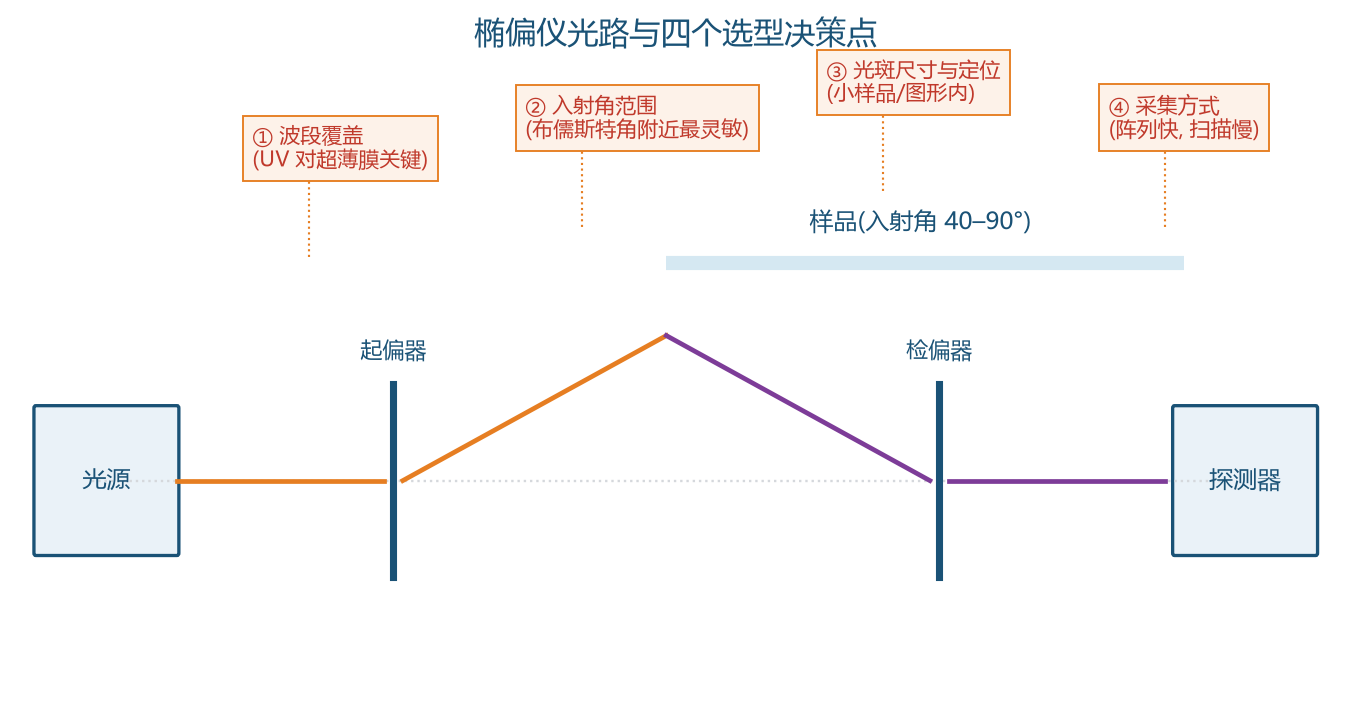
Start with the spectral band. An ellipsometer's band determines what it can "see". The ultraviolet range (190–400 nm) is critical for ultrathin films and semiconductor materials: the shorter the wavelength, the stronger the phase information from ultrathin films, and many semiconductor materials have absorption bands in the UV. Visible-to-near-infrared is the general-purpose mainstay; the near-infrared extension (to 1700 nm) serves thick transparent layers and free-carrier concentration measurements. The first question of selection is: which band does your film stack need for the information to be solved out? For ultrathin-film users, UV coverage comes first — it is a hard constraint.
Angle of incidence is the second question. A variable angle of incidence (typically 40–90 degrees) adds data dimensions and is highly valuable for solving multilayers and anisotropic materials; fixed-angle models are cheaper and faster, suited to production-line monitoring of known film stacks. Sensitivity peaks near the Brewster angle, so the incidence-angle range determines how well you cover the "sweet spots" of different substrate/film-stack combinations.
Spot size is the third question. A conventional spot is millimeter-scale, with good signal; but advanced processes require measuring inside the scribe lines of patterned wafers, perovskite samples may be only a few millimeters across, and industry samples come with their own patterns — all of these need a micron-scale focused spot plus camera-based positioning. Shrinking the spot degrades the signal-to-noise ratio; this is a trade-off without end. When selecting, work backward from your smallest "measurable area" to the spot requirement.
Then come three easily overlooked parameters. First, automated mapping capability: whether it can do wafer-level mapping, load and unload wafers automatically, and integrate with process tools determines whether it is a laboratory instrument or a production-line metrology tool — the two forms differ by an order of magnitude in price. Second, data acquisition speed and number of spectral points: scanning spectral ellipsometers acquire wavelength by wavelength and are slow, while array-based instruments capture the full spectrum in a single exposure and are fast; film-thickness monitoring applications are more sensitive to speed than one might imagine. Third, the software model ecosystem: how many calibrated dispersion models are in the materials library, how usable the parameter-correlation analysis tools are, and whether multilayer batch processing is supported. Half of an ellipsometer's value lies in the software — the same logic as in "Refractive Index and Thickness Coupling".
In terms of product form, modern ellipsometers split into two camps: research-grade and production-line grade. Research grade pursues spectral band, angles, accuracy, and modeling freedom; production-line grade pursues speed, stability, automation, and integration with line data systems. Acuitik's ES-Primo belongs to the former — officially positioned as a multi-wavelength instrument aimed at ultrathin films and complex multilayer structures — while the ES-Tenso serves general-purpose measurement in research settings. The two lines call for different budgets and different evaluation criteria: research grade is judged on accuracy and functionality, production-line grade on repeatability, uptime, and service.
One last piece of experience: the learning cost of an ellipsometer is higher than that of a film thickness gauge, and the team needs at least one person who truly masters the modeling. Write the vendor's training and modeling support into the contract — the return on that investment is exceptionally high.
About Acuitik
Acuitik specializes in optical precision measurement technology. Its core products are reflectance-based film thickness gauges, ellipsometers, and OEM film thickness sensors featuring "non-contact, non-destructive, sub-nanometer accuracy":
- Industrial film thickness measurement NS series: NS-20 manual, NS-30 automated Mapping, NS-Micro microscopic, NS-Touch curved-surface, NS-HR thick-film, NS-100 high-speed line-scan
- Research-grade measurement ES series: ES-Tenso ellipsometer, ES-Primo multi-wavelength ellipsometer (for ultrathin films and complex multilayers), plus the NS-Vista dual-channel and NS-Flex portable multimodal units
- OEM film thickness sensors: multi-point nanoscale film thickness, NS-HR thick-film, and NS-Micro microscopic sensor modules, supporting Modbus / OPC UA for integration with PLC and MES, with an SDK provided
The instruments are metrologically certified by the National Institute of Metrology of China and the Shanghai Institute of Measurement and Testing Technology, and Acuitik participated in drafting the group standard T/CIET 2298-2026 "Calibration Specification for Thin-Film Interference Film Thickness Measurement Systems". For more selection guides and application notes, please visit the Acuitik official website.