A common purchasing puzzle: among reflectance-based film thickness gauges, models for sub-100-nm thin films cost considerably more than models for micron-scale thick films, even though "thick" looks hard and "thin" looks easy. The truth is exactly the opposite. This article uses fringe physics to work out the accounting.
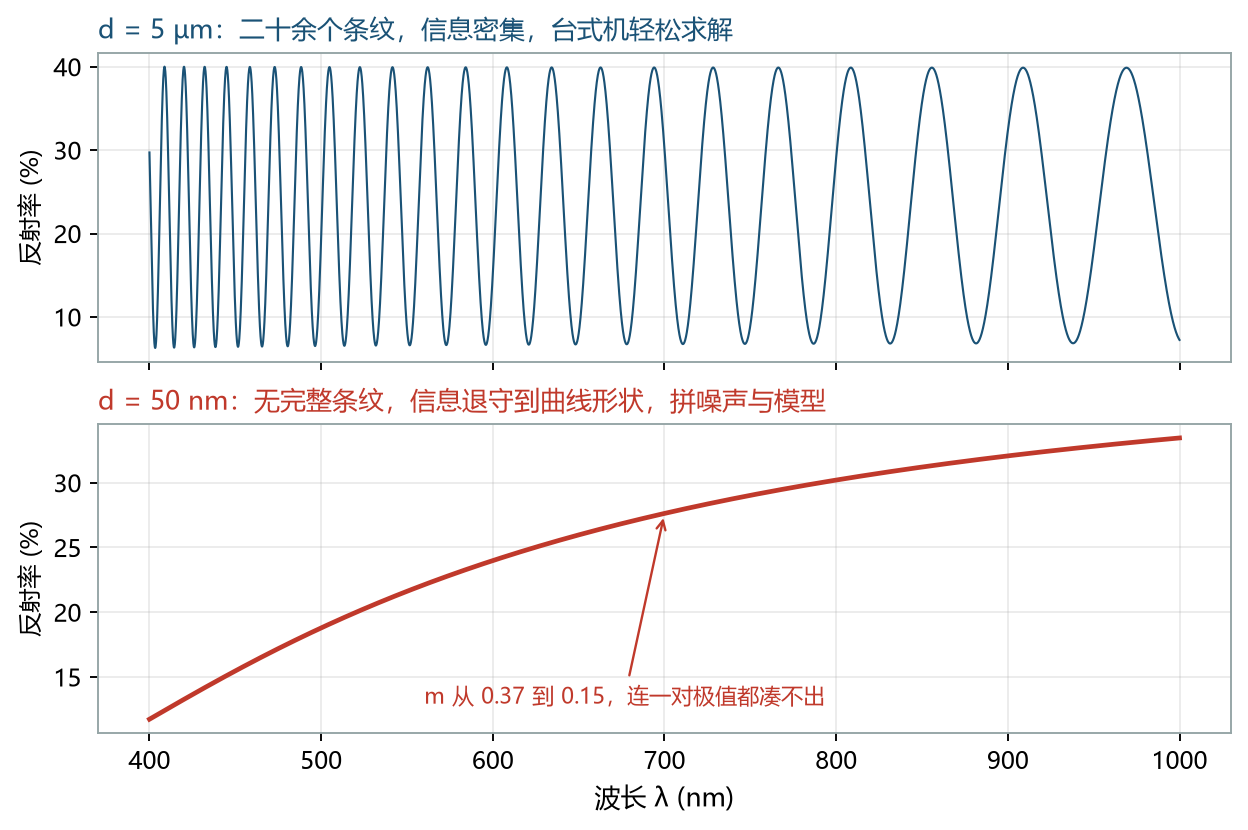
Recall the extremum condition 2nd = m·λ. For silicon dioxide on silicon at normal incidence, a 50 nm film gives an optical path difference of 2nd = 146 nm: across the 400–1000 nm visible band, m goes from 0.37 to 0.15 — not even one complete extremum cycle. There are no fringes in the reflectance spectrum, only a slowly bending curve. A 5 µm film gives 2nd = 14600 nm, and m sweeps through more than twenty cycles, with fringes as clear as a comb. The information content of the two cases differs by more than an order of magnitude — that is the physical origin of the price difference.
Without fringes, the information retreats into the shape of the curve: the refractive index and thickness of an ultrathin film affect how strongly the spectrum bends at the short-wavelength end and the phase at the interfaces. To read the information contained in that shape, an instrument must pass three gates.
Gate one: go shorter in wavelength. The shorter the wavelength, the larger the phase difference for the same film thickness, and the more pronounced the curve's "bending". Deep-UV models can pull up information from ultrathin films at the 2 nm scale, but each push of the band toward the ultraviolet requires a new generation of light source (deuterium lamp), optics (UV-transmitting materials), and detector — and the cost jumps a tier accordingly.
Gate two: suppress noise. Reading the shape of a curve is extremely sensitive to noise — source fluctuation, detector read noise, ambient stray light, and mechanical vibration of the sample stage all write themselves directly into the spectrum. Stabilized source current, cooled detectors, extended averaging, temperature-stabilized optics: these "invisible configurations" are exactly where the price premium of thin-film models lives.
Gate three: stronger physical models. In the ultrathin-film regime the coupling between n and d is at its worst (see "Refractive Index and Thickness Coupling"), and ordinary polynomial dispersions are not enough — physical models such as Forouhi-Bloomer and Tauc-Lorentz are needed. The depth of the fitting engine and materials library directly determines how trustworthy the result is.
Once these three gates are passed, the shape of a thin-film model becomes clear: wide spectral band (UV coverage), low noise, strong models — and naturally a price an order of magnitude higher. The ellipsometer's advantage in the ultrathin regime lies here as well: the sensitivity of phase measurement is inherently suited to the sub-nanometer scale (see "What Is an Ellipsometer").
The takeaway for users: first pin down the lower limit of your thin films. If your target thickness is below 10 nm, bring ellipsometry into the comparison directly — don't choose only among reflectance-based instruments. If it falls between 10 nm and 100 nm, make "spectral band starting point", "noise specifications", and "measured thin-film repeatability data" the top three priorities when selecting a reflectance-based model. Commercial models differ widely in this range. Take Acuitik's NS-30 as an example: the official specification lists a minimum measurable thickness below 10 nm, and there is only one way to verify such a claim — measure your own thin-film samples and check both the repeatability and the reconciliation against electrical or step-height methods.
About Acuitik
Acuitik specializes in optical precision measurement technology. Its core products are reflectance-based film thickness gauges, ellipsometers, and OEM film thickness sensors featuring "non-contact, non-destructive, sub-nanometer accuracy":
- Industrial film thickness measurement NS series: NS-20 manual, NS-30 automated Mapping, NS-Micro microscopic, NS-Touch curved-surface, NS-HR thick-film, NS-100 high-speed line-scan
- Research-grade measurement ES series: ES-Tenso ellipsometer, ES-Primo multi-wavelength ellipsometer (for ultrathin films and complex multilayers), plus the NS-Vista dual-channel and NS-Flex portable multimodal units
- OEM film thickness sensors: multi-point nanoscale film thickness, NS-HR thick-film, and NS-Micro microscopic sensor modules, supporting Modbus / OPC UA for integration with PLC and MES, with an SDK provided
The instruments are metrologically certified by the National Institute of Metrology of China and the Shanghai Institute of Measurement and Testing Technology, and Acuitik participated in drafting the group standard T/CIET 2298-2026 "Calibration Specification for Thin-Film Interference Film Thickness Measurement Systems". For more selection guides and application notes, please visit the Acuitik official website.