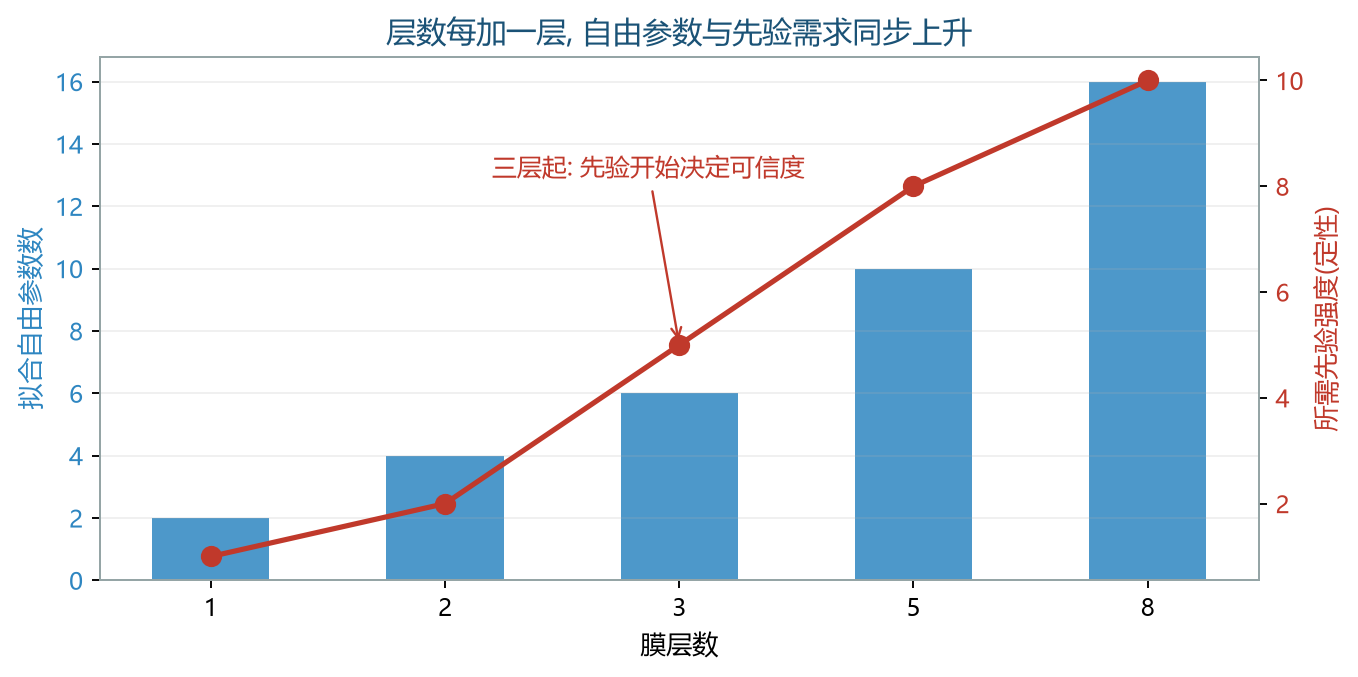
The same reflectance-based film thickness gauge can deliver rock-solid results on a single-layer film and wildly unreliable ones on an eight-layer stack. The difference lies not in the instrument but in the mathematics: the number of free parameters in the fitting problem determines how easily it can be solved — and how easily it can be solved wrongly. This article draws the boundary of trustworthiness as a function of layer count.
Single-layer films are home ground for this method. There are only two unknown parameters (d and n, or d plus a few coefficients of a dispersion model), while a broadband spectrum provides dozens to hundreds of data points — the fitting equations far outnumber the unknowns, and the solution is stable. As long as the fringe quality is normal and the material has a model, the result can be used with confidence. The check is simple, too: overlay the fitted curve on the measured spectrum. If the full spectrum matches and the parameter correlation matrix shows no anomalous coupling, the thickness is trustworthy.
Double-layer films are where the watershed appears. The unknown parameters double (two sets of d and n), and at least one layer needs prior knowledge: either its refractive index is already known (a mature process, ample literature), or a thickness-range constraint is supplied. A double-layer fit without prior knowledge is not impossible to compute — the problem is that the result wanders among a set of equivalent solutions: same spectrum, different initial value, different thickness combination. The instrument will still report a seemingly normal number; the responsibility for judgment shifts to the user.
For film stacks of five layers or more, the problem becomes mathematically ill-conditioned: the parameter space contains a large number of nearly equivalent solutions, and the fitting algorithm can only converge to one of them. The trustworthiness of such measurements no longer depends on the instrument itself but on four conditions coming together: reliable prior optical constants for every layer, sufficiently wide spectral coverage, a sufficiently high signal-to-noise ratio (SNR), and a sufficiently stable process (no drift in layer-to-layer thickness). When all four are in place, industrial software can handle complex stacks — the Acuitik official website states that its analysis software can handle multilayer structures of more than 100 layers. The correct way to read such a claim is "solving power within a strong prior framework", not "puzzle-solving out of thin air".
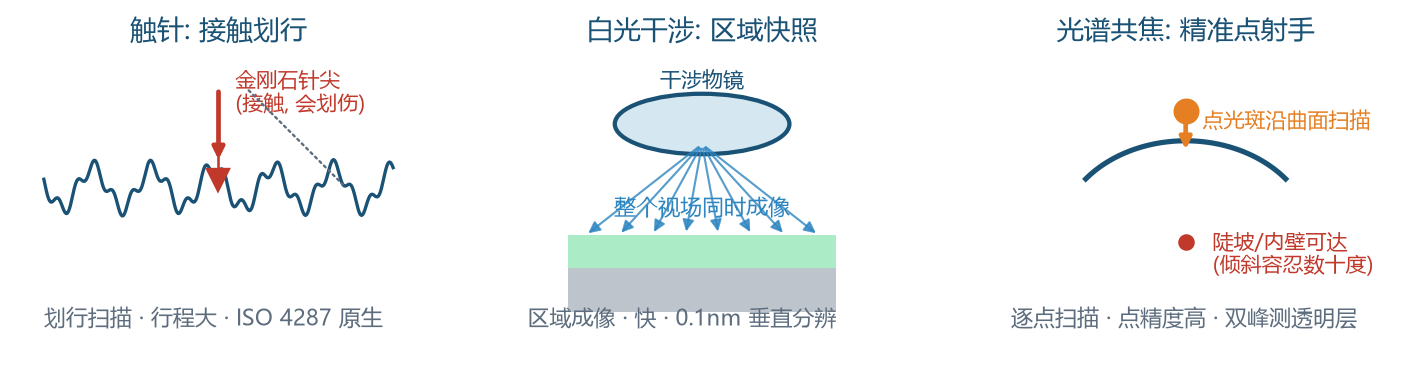
Three field-proven working practices apply here. First, start from the simplest model: fit the top layer as a single film, confirm it is trustworthy, then add layers going down, checking the fitting residuals each time a layer is added. Second, lock down the parameters the process has already determined: for example, if a layer is known to be silicon dioxide grown by thermal oxidation, fix its dispersion model and let the fit solve only the uncertain layers. Third, cross-validate with an independent method: a multilayer stack should have at least one step height (total thickness measured by stylus profilometry or white-light interferometry) or a single-layer reference coupon. If the optically fitted total thickness disagrees with the mechanically measured one, the problem is definitely in the model.
The implication for selection is direct: if your product is a multilayer stack, the focus of evaluation should shift from "instrument accuracy" to "the software's modeling capability and the service team's multilayer experience". Whether a vendor dares to take your real film stack and run it as a blind test says more than any demonstration.
About Acuitik
Acuitik specializes in optical precision measurement technology. Its core products are reflectance-based film thickness gauges, ellipsometers, and OEM film thickness sensors featuring "non-contact, non-destructive, sub-nanometer accuracy":
- Industrial film thickness measurement NS series: NS-20 manual, NS-30 automated Mapping, NS-Micro microscopic, NS-Touch curved-surface, NS-HR thick-film, NS-100 high-speed line-scan
- Research-grade measurement ES series: ES-Tenso ellipsometer, ES-Primo multi-wavelength ellipsometer (for ultrathin films and complex multilayers), plus the NS-Vista dual-channel and NS-Flex portable multimodal units
- OEM film thickness sensors: multi-point nanoscale film thickness, NS-HR thick-film, and NS-Micro microscopic sensor modules, supporting Modbus / OPC UA for integration with PLC and MES, with an SDK provided
The instruments are metrologically certified by the National Institute of Metrology of China and the Shanghai Institute of Measurement and Testing Technology, and Acuitik participated in drafting the group standard T/CIET 2298-2026 "Calibration Specification for Thin-Film Interference Film Thickness Measurement Systems". For more selection guides and application notes, please visit the Acuitik official website.