Nickelate Thin-Film Ellipsometry Characterization
Perovskite · Dedicated Modeling · Precise Film Thickness
In strongly correlated oxide research, the three rare-earth nickelate perovskite thin films LaNiO₃, NdNiO₃, and SmNiO₃ — with their tunable metal-insulator transition, excellent infrared optical response, and electrical tunability — have become core research systems for intelligent optoelectronic devices, phase-change switches, thermal sensors, and transparent conductive films.
Yet many R&D and production teams widely face the same challenge: the three materials are structurally similar but vastly different in properties, and their ultra-thin, highly sensitive nature means conventional testing cannot characterize them precisely. Ordinary spectra cannot separate the phase-change signal from defect noise, and traditional testing struggles to fit film thickness and optical parameters accurately.
Today, in three parts — material properties → measured characterization → hard-core instrument advantages — we break down completely how the Acuitik spectral ellipsometer is specifically adapted to the three nickelate films, solving the testing pain points of strongly correlated phase-change materials.
01 | Material Background: Three Rare-Earth Nickelates with Completely Different Properties and Applications

Rare-earth nickelates share the general formula RNiO₃ and belong to the classic strongly correlated perovskite family. Simply by changing the rare-earth ion, wide-range tuning of metallic conductivity, transition temperature, and optical response can be achieved — making them hot materials in today's phase-change electronics, infrared optics, and novel sensor fields.
But the three materials differ enormously in research scenarios, property characteristics, and testing difficulties — the same characterization logic cannot be applied to all.
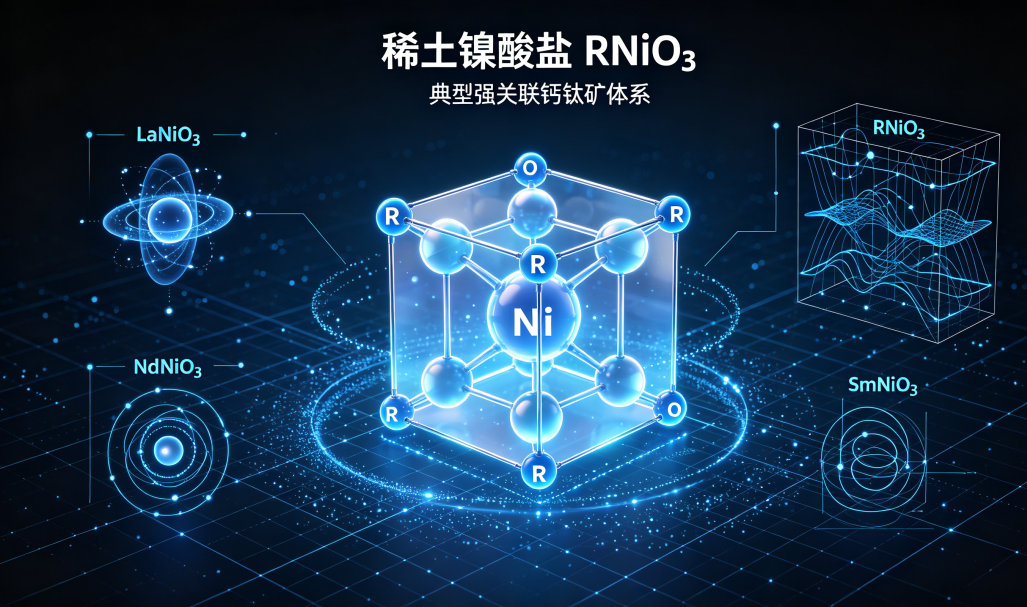
- LaNiO₃ (LNO) — Steady-State Metallic Conducting Film
La³⁺ has the largest ionic radius; the film remains in a stable metallic state at room temperature throughout, with no metal-insulator transition. Films offer high epitaxial quality, good flatness, and strong repeatability.
Testing pain point: precisely obtaining ultra-thin film thickness and stable n/k optical constants is required; oxygen vacancies and interface defects directly affect conductivity, and conventional testing cannot quantify the defects' impact on optical and electrical properties.
- NdNiO₃ (NNO) — The Core Room-Temperature Phase-Change Material
It possesses a reversible metal-insulator transition near room temperature, a moderate transition temperature window, high sensitivity to stress, oxygen partial pressure, and film thickness, plus a strong transition response with excellent tunability.
Testing pain point: optical parameters change abruptly before and after the transition, and ordinary spectra cannot distinguish the "phase-change signal" from "film defect noise," making it hard to precisely capture the optical evolution near the transition critical point.
- SmNiO₃ (SNO) — Hysteresis-Free Phase-Change Functional Film
A classic strongly correlated phase-change material with a transition temperature of about 130°C; its greatest advantages are minimal transition hysteresis and excellent cycling stability. Tiny process fluctuations can tune the transition characteristics, making it an ideal controllable phase-change functional material.
Testing pain point: the film is extremely sensitive — substrate signals, surface roughness, and trace oxygen defects all severely interfere with test results, urgently demanding high-precision layered modeling to strip out the interference.
next

Shared characterization challenges of the three materials
Film thicknesses mostly cluster in the ultra-thin 40–100 nm range:
- Stylus profilometry contact testing easily damages the film and lacks precision;
- AFM only sees topography and cannot obtain optical constants or carrier information;
- Transmission/reflection spectra cannot separate the superimposed signals of substrate, interface, functional layer, and roughness layer.
Spectral ellipsometry is therefore the best-matched, highest-precision non-destructive characterization solution for nickelate films today.
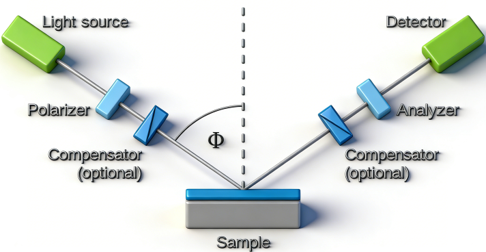
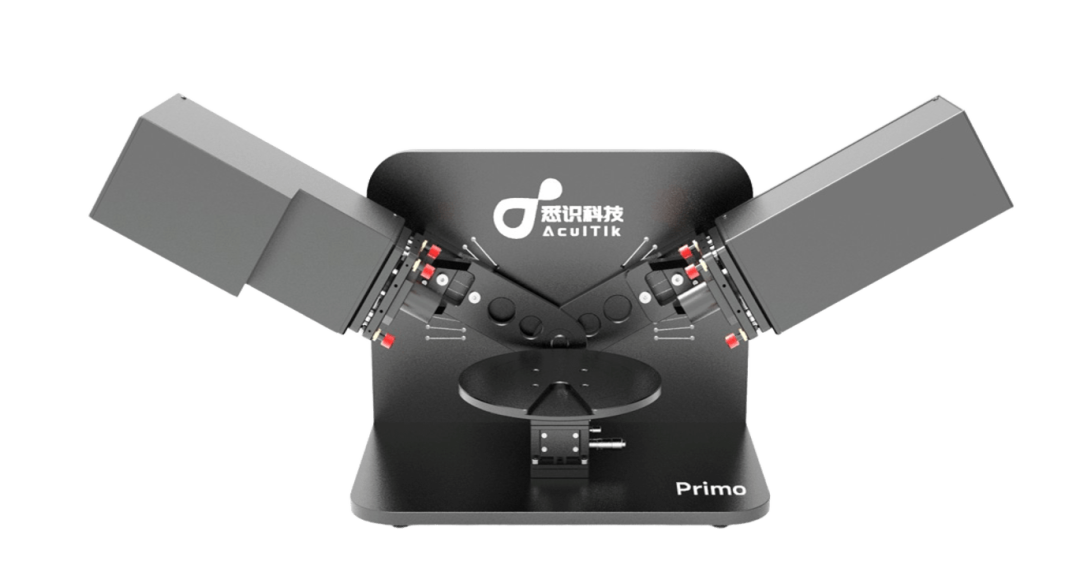
02 | Acuitik ES-Primo: A Dedicated Measured Solution for RNiO₃-Series Films
For the three strongly correlated, phase-change, highly sensitive nickelate films LaNiO₃, NdNiO₃, and SmNiO₃, the Acuitik spectral ellipsometer ships with a dedicated dispersion model library for advanced materials, enabling targeted modeling, precise fitting, and parameter inversion — perfectly solving the industry pain points of "outdated models, inaccurate fitting, and high MSE" in conventional equipment.
- Differentiated modeling solutions (core advantage)
LaNiO₃ steady-state metallic model
Precisely matches the free-carrier absorption of LNO's room-temperature metallic state and stably fits interband transitions across the full band, outputting film thickness, roughness, and optical constants with extremely high repeatability — suited to conducting-film process calibration.
NdNiO₃ / SmNiO₃ phase-change material models
Addressing the multi-level electronic transition characteristics of strongly correlated systems, multiple oscillators reproduce the complex optical response and can precisely distinguish the spectral differences between metallic and insulating states — perfectly suited to phase-change film testing needs.
- Full set of measured data output
Fitting analysis through project files (STK) delivers research-grade complete parameters in one click:
• Precise film thickness, surface roughness, and uniformity parameters
• Full-band refractive index n, extinction coefficient k, and dielectric function spectra
• Fitting MSE error to quantify data reliability
• Extendable to in-situ variable-temperature testing, tracking the dynamic optical evolution through the transition
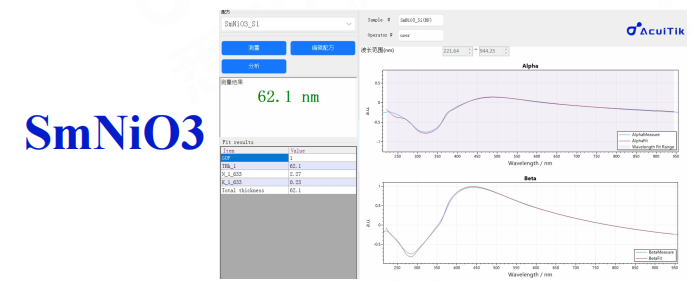
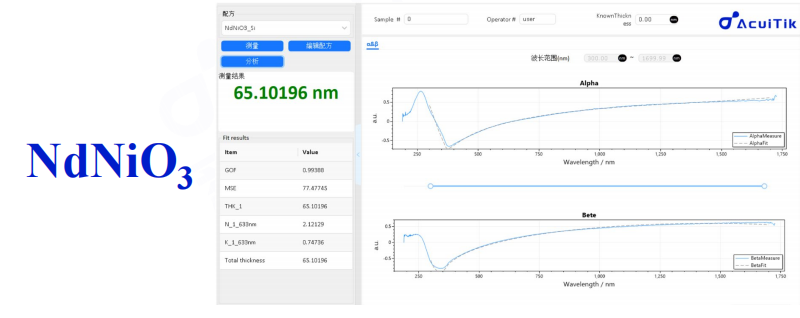
Measured curves fit with high overlap and strong data stability, ready to be used directly for paper figures, process iteration, and device simulation parameter inputs.
03 | Ellipsometer Core Advantages: Designed for Emerging Advanced Films
Most ellipsometers on the market are adapted only to traditional dielectric and semiconductor films; facing strongly correlated oxides, phase-change materials, and novel conductive films, they often "measure but misfit." The Acuitik spectral ellipsometer is deeply specialized in advanced functional film characterization, with all-around advantages for nickelates and other emerging materials.

✅ Massive library of dedicated dispersion models for advanced materials
Built-in Cauchy, Sellmeier, Drude, Lorentz, Tauc-Lorentz, multi-oscillator combinations, EMA effective medium models, and a full algorithm suite — not only fitting routine calibration standards, but also holding mature fitting templates for phase-change nickelates such as LaNiO₃, NdNiO₃, and SmNiO₃, novel oxides, nitrides, and ultra-thin films, solving the pain points of difficult modeling and poor fitting for new materials.
✅ Precise multilayer analysis that strips substrate and interface interference
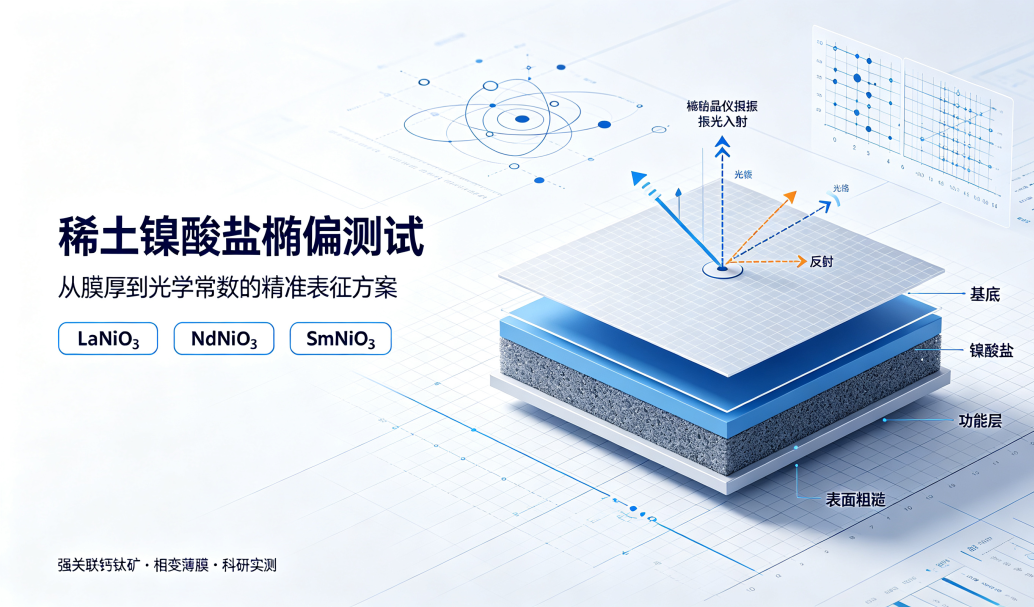
Supports four-layer structure modeling of "substrate — interfacial transition layer — functional film — surface roughness layer," precisely stripping out substrate signals, interface defects, and surface roughness interference to faithfully recover the film's intrinsic optical and structural parameters — especially suited to epitaxially grown nickelate films.
✅ Sub-nanometer measurement precision, suited to ultra-thin films
For ultra-thin phase-change films of a few tens of nanometers, it achieves sub-nanometer film thickness resolution with high data repeatability, precisely reflecting the subtle differences among magnetron sputtering, PLD, and ALD preparation processes to support process optimization.
✅ Open scientific modeling with extremely high freedom
Supports custom oscillator counts and free combination of dispersion models, without relying on literature default parameters; for advanced new materials without standard models, you can build your own optimal fitting scheme — a complete fit for frontier research at universities and institutes.
LaNiO₃'s steady-state conduction, NdNiO₃'s room-temperature transition, and SmNiO₃'s hysteresis-free response give the three rare-earth nickelates distinct strengths and clear application scenarios — while placing extreme demands on characterization precision. Accurate ellipsometric modeling and data analysis are the key prerequisites for mechanism research, process optimization, and device realization of nickelate films.
With its rich reserve of advanced-material models, high-precision multilayer fitting algorithms, and open research-grade operating logic, the Acuitik spectral ellipsometer can solve the testing challenges of the three nickelate films in one stop, continuously empowering research on strongly correlated phase-change materials and novel optoelectronic functional films.
summary
How deep research on nickelate films can go often depends on the precision of optical characterization. For LaNiO₃'s steady-state metallic characteristics, NdNiO₃'s room-temperature phase-change characteristics, and SmNiO₃'s hysteresis-free phase-change characteristics, Acuitik ships multiple sets of dedicated dispersion models for advanced materials, enabling rapid modeling, fitting, and parameter inversion, suited to the testing of the vast majority of emerging strongly correlated films, ultra-thin functional films, and phase-change films.
For nickelate-specific fitting templates, STK recipe data export tutorials, and measured case data, leave us a message in the background — we keep sharing hands-on ellipsometry know-how for advanced films.